Musical (2005)
Based on the film Monty Python and the Holy Grail (1975)
Music, Lyrics and Book by Eric Idle
Music by John Du Prez
Director and Choreographer: Josh Rhodes
Music Supervision and Additional Arrangements: John Bell
Boch Center – Wang Theater
Theater District, Boston
October 8-11, 2026
Music Director: Jonathan W. Gorst; Scenic & Projection Design: Paul Tate dePoo III; Costume Design: Jen Caprio; Lighting Design: Cory Pattak; Sound Design: Kai Harada & Haley Parcher; Hair & Wig Design: Tom Watson; Dialect Coach: Patrick Mulryan; Orchestrator: Larry Hochman; Associate Director: Derek Van Baruri; Associate Choreographer: Michael Fatica; Production Stage Manager
With Major Attaway (King Arthur); Sean Bell (Sir Robin); Chris Collins-Pisano (Sir Lancelot); Ellis C. Dawson III (Sir Bedevere); Leo Roberts (Sir Galahad); Amanda Robles (The Lady of the Lake); Blake Segal (Patsy); Steven Telsey (The Historian/Prince Herbert); Ensemble: Lindsay Lee Alhadeff, Delaney Benson, Jack Brewer, Jonathan Bryant, Connor Coughlin, Leeds Hill, Logan Jones, Graham Keen, Claire Kennard, Ben Lanham, Kendall Leshanti, Nathaniel Mahone, Maddie Mossner, Emilee Reiner, Mark Tran Russ, Merideen Terrell
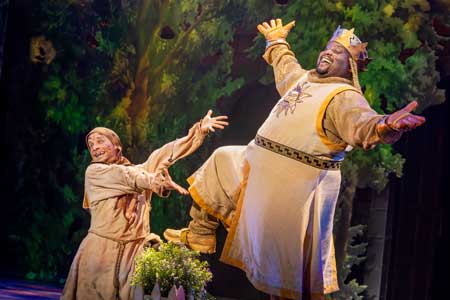
Major Attaway as Arthur
in “Spamalot”
Photo: Matthew Murphy and Evan Zimmerman
If there is a plot to this romp, it’s that Arthur (Major Attaway) discovers the Lady in the Lake (Amanda Robles) who gives him the sword which leads to his kingship and not long afterwards to connecting up with Sir Galahad (Leo Roberts) and Sir Lancelot (Chris Collins-Pisano). They take off on the quest for the Holy Grail, which, before long, turns into a quest for writing a successful musical.
The virtue of Monty Python’s Flying Circus and all of the attendant films including Monty Python and the Holy Grail (1975) and Monty Python’s Life of Brian (1979), is its tight-lipped British humor seasoned with anarchic rambunctiousness. That combination was a devilishly successful one that enabled Monty Python’s great team – John Cleese, Eric Idle, Graham Chapman, Terry Gilliam, Eric Idle, Terry Jones and Michael Palin – to succeed at putting forth a wonderfully wild repertoire that had its own distinctive tone and style. For those who love Monty Python, there is nothing quite like its fusion of utter silliness with erudition and the posed formality and decorum that frames it all.
This musical, written by Eric Idle, takes many of the themes of the original shows and films, but mostly from the film Monty Python and the Holy Grail (1975) and gloms them together with a loose narrative that it spoofs on, especially in the second half, adding some not very distinctive music to it.
The staging of this production is oddly flat and linear, with sets that are quite straightforward and do not move too much, and a form of general design and choreography that does not enliven things much beyond that. There is some good acting in this show – Major Attaway as King Arthur is robust and compelling, and Chris Collins-Pisano as Lancelot gives a good broad rendition – but overall the show is fairly discombobulated. What made Monty Python shows and films attractive were that they were intentionally anarchic, which was appealing and funny. Here, the show just seems to ramble on and fall apart in a lot of places.
It is slower in the first half, where the more general spoofs on King Arthur, Camelot, and the knights are presented. In the second half, when the fourth wall collapses and there is a lot more focus on what it means to produce a successful musical, things pick up, but at an odd cost. There is a long song about the role of Jews in Broadway production which is, of course, tasteless, and could be funnier that it is. There is plenty of Broadway stuff which is tasteless – almost all of The Producers (the 2001 musical based on the 1967 film) or The Book of Mormon (2011) qualifies – that is genuinely funny. Even though the pace picks up in the second half of this production, it does so at the expense of what made Monty Python so great – its artful combination of restraint and anarchy within the tight bounds of an aesthetic of British-style humor. Here, those boundaries are exploded, and not for the best.
A lot of the Monty Python shtick is included in the script – Spam (the meat, not the email), of course, from the noted 1970 Spam, spam, spam, spam… Monty Python routine, the clopping coconut shell horses from Monty Python and the Holy Grail, and a bunch of other stuff. There is a lot of weirdly antiquated gay-related spoofing that goes on, with Sir Lancelot depicted as a gay guy. One funny line does emerge, when Lancelot and one of the other gay characters – talking from the Middle Ages – self-reflect and says it’s odd that this will still be controversial a thousand years from now. That truly is funny.
There is also a lot of pop culture reference, including medleys of songs from Whitney Houston and others, which are irrelevant to the plot but which seem to gain favor with a willing audience. And there are also the cheap but popularly appealing references to local Boston things, which also gets a big rise from audiences. It must be a full time job for the writers to come up with this stuff for every venue – the current tour is scheduled to go to six other cities in the next few weeks.
Some Monty Python fans may be charmed by the look back, which others may be daunted by the lack of real dedication to the Monty Python esthetic. I am more in the latter camp, but found some of the performances appealing and enjoyed some of the perkiness of the second half even though it represented a greater departure from the traditional Monty Python gaggery.
– BADMan (aka Charles Munitz)
Leave a Reply