Play (2024)
BY Kelundra Smith
Directed by Tasia A. Jones
Front Porch Arts Collective
Boston Center for the Arts
South End, Boston
October 31 – November 22, 2026
Assistant Director / Dialect Coach: Nirah Michel; Stage Manager: Tara Hightower; Stage Manager: Gabby Stryker; Sound Designer: Joshua Jackson; Scenic Designer: Janie E. Howland; Lighting Designer: Amanda E. Fallon; Projection Designer: Pamela Hersch; Costume Designer: Athena Parkman; Associate Costume Designer: Zoe Sundra; Costume Assistant: Marissa Wolf; Props Designer: Julia Wonkka
With MaConnia Chesser (Jeanie), MarHadoo Effeh (Thomasine), Eliza Fichter (Mozelle), Lindsey McWhorter (Anna), Jada Saintlouis (Charity), Kiera Prusmack (Jewel)
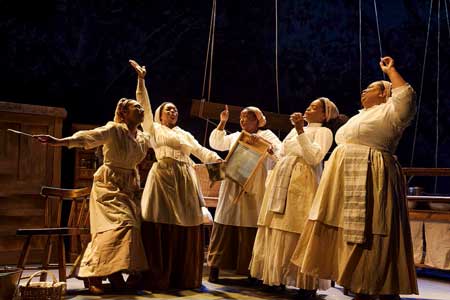
Lindsey McWhorter as Anna
Jada Saintlouis as Charity
MarHadoo Effeh as Thomasine
MaConnia Chesser as Jeanie
in “The Wash”
Photo: Ken Yotsukura
Courtesy of Front Porch Arts Collective
It is the summer of 1881 in Atlanta. Thomasine (Marhadoo Effeh) runs a clothes washing operation with her partner Jeanie (Maconnia Chesser) and a group of other hard-working, underpaid, African-American women: Anna (Lindsey McWhorter), Jewel (Kiera Prusmack) and Charity (Jada Saintlouis). When they try to get paid for their work, doors are slammed in their faces, and their frustration mounts. They decide, in a moment of incredible and justified frustration, to go on strike. They realize that in order to be effective they have to get many of the other washerwomen in Atlanta to join them, and begin to reach out to other groups of them. Before very long they have several thousand other women who have joined their effort. Some of these are white women, of which Mozelle (Eliza Fichter) is a representative, and which poses some obvious challenges. (To see what happens, consult the Spoilers section below.)
This moving and interesting story about a terrific group of women who seek justice for their efforts proceeds apace and develops with an implicit dramatic concern about the fate of their initiative. Playwright Kelundra Smith has fashioned a diverse collection of women, all with different issues and orientations, but similarly engaged in work and the effort to demand compensation for it. There are certain untoward consequences that follow from their efforts, and when we see Thomasine return after being beaten, we understand the significance of the locals’, and local government’s, reaction to this organizational effort by black women in a Southern state still very much gripped in the hands of Jim Crow.
This is a wonderful ensemble piece, given coherence and vividness by the actors and by director Tasia A. Jones. As Thomasine, Marhadoo Effeh is heartbreakingly solid and determined, seemingly punctured by the violence surrounding her, but determined to see through to the end. As Jeanie, Maconnia Chesser is an effectively wry wisecracker who keeps things lively and rolling free. In Jewel, a character of distinctive physical beauty, Kiera Prusmack finds the delicate articulateness needed to convey her particular closeness to a female friend and pulls it off convincingly. Jada Saintlouis gives a warm and robust spin to Charity, who seeks motherhood along with justice. And as Mozelle, the white woman who comes to join the strike and has to confront the suspicions of the group of black women who do not trust her initially, Eliza Fichter does a sharp and compelling job.
At the end, in a celebratory gesture, all of the women don beautiful African costumes (Costume Design by Athena Parkman and Zoe Sundra), evoking the sense of color and vitality that their gesture of self-representation infused into their collective lives.
Overall, this is a wonderful history lesson, and a great evocation of the spirit of organized labor.
– BADMan (aka Charles Munitz)
Leave a Reply