Concert
Boston Modern Orchestra Project
Gil Rose, conductor and artistic director
Jordan Hall
Symphony Hall area, Boston
November 6, 2026
Jiggedy jingle jaunty jaunty (2026)
World Premiere
Samuel Barber
Knoxville: Summer of 1915 (1947)
Julia Bullock, soprano
Matthew Aucoin
Two Arias from “The No One’s Rose” (2021)
I. There was earth inside them.
II. It’s all different from what you think
Julia Bullock, soprano
Connie Converse
One by One
Arranged by Matthew Aucoin
Julia Bullock, soprano
Charles Wuorinen
Delight of the Muses (1991)
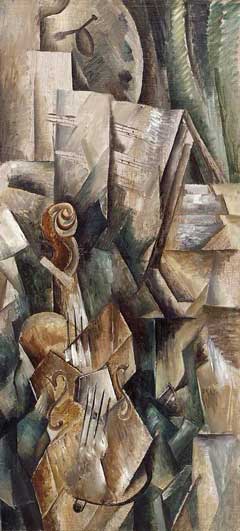
Violin and Palette (1909)
The Solomon R. Guggenheim Museum, New York, NY
There was a lot of great text included in this varied and stimulating program, and it was wonderfully rendered, in large part, but not exclusively, by the captivating and full-voiced soprano Julia Bullock.
A new piece by Anthony Paul de Ritis, entertainingly titled Jiggedy jingle jaunty jaunty, received its world premiere at this concert. The text supporting, supported by, or more properly, commingled with, this composition is from the Sirens chapter of James Joyce’s Ulysses. In that episode of Ulysses, Joyce’s middle-aged protagonist, Leopold Bloom, is in a tavern and fearing and anticipating the rendezvous his wife is going to have with the rival Blazes Boylan. The episode, in addition to being filled with tavern sounds, was intentionally crafted by Joyce with a musician’s ear in mind, framing language to suit the musical temperament, with onomatopoeia, syncopation, and overlapping voices. De Ritis’ piece does wonderful justice to this effort, with a constancy of bar rumble in the background, punctuated throughout with the selected text from Ulysses and the ongoing sense of Leopold as cuckolded husband and vagabond in the life of Dublin, on the run, encountering this and that one in the course of his travels and full of life and worry. There is an overall consuming richness to de Ritis’ score, and its robust intensity and musical frolic with the text is a delight throughout.
Samuel Barber’s Knoxville: Summer of 1915 is a pastoral endeavor, broad and thematic in its scope, and warmly evocative of the landscape, the countryside and the qualities of life that abound there. Hints of spirituals can be heard within the cracks, and little touches of the sorts of melodic improvisations that gave Dvorak some fun from his own time in America. It is mostly cast in this romantic temperature, but one can detect elements of shadow and concern, and one wonders how much questions of Southern racism, though not explicit, might have entered into Barber’s compositional agenda.
Matthew Aucoin’s Two Arias from “The No One’s Rose”, composed five years ago, is full of unexpected twists and turns. It is lyrical and vivid, and with Julia Bullock’s rendering of the text by poet Paul Celan, it creates intensity, depth and grandeur in one fell swoop. There is something dramatic and unexpected in much of the writing, and though it leans heavily on the existential gravity of the Celan text, there is something persuasively shocking about how Aucoin frames it that makes it exciting. The first Celan poem, Es var Erde in ihnen, There was earth inside them was sung in German. The second, It’s all different from what you think – don’t you love that title? – was sung in English, both magnificently by Bullock.
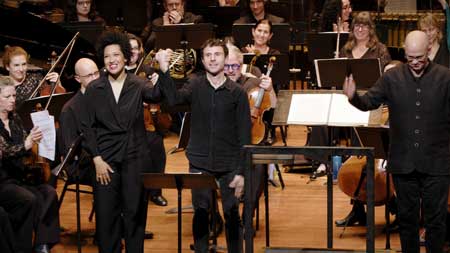
Matthew Aucoin
Gil Rose
Photo: Luke Damrosch
Courtesy of Boston Modern Orchestra Project
An unannounced rendition of One by One by Connie Converse (American, 1924-1974), set by Matthew Aucoin, was a charming postlude to the preceding pieces, with Bullock’s rich, resonant voice filling out the space above Aucoin’s delightful setting. Bullock introduced the piece, which she said reminded her of Schubert.
The concert wound up with Charles Wuorinen’s Delight of the Muses written in the early 1990s with a kind of tongue in cheek satirical pose. It is a takeoff gag on Mozart and is so filled with Mozartean elements cut, pasted and glommed back together that is is extremely fun to listen to. In four movements, and fairly long overall, it follows a Mozart-like sequencing, but as though Picasso had taken a photograph of the Mozartean corpus and turned it into a nice Cubist reconstruction. The piece is not moving as much as it is funny. Nor is it jazzlike in its reconstruction of Mozart as much as it is a satire on Mozartean style. It is extremely entertaining and one feels that Wuorinen could have kept it going even longer than he did. It seems like he must have had a lot of fun writing this, and the amusement comes through clearly. Though a satirical takeoff, the piece has a lot of very challenging passages, and putting it all together is no mean feat. Here, conductor Gil Rose, as well as the instrumental ensemble, played precisely and wonderfully, as they did in the earlier compositions which certainly each had their own significant challenges.
A few particular notes on the performances …
Anthony Paul De Ritis
Jiggedy jingle jaunty jaunty (2026)
A wild bar. The voices rise over the din. Its a roar, with some recorded voices, rumbling underneath. The sea, the sea! Waves of longing. Words head partially as in subliminal imagination. The roar of consciousness, with some thematic objects. Opera emerges, the jingle jangle jaunty. Insistent strings, the beating brass. The penetrating insistence. Plink plank. Awash in thoughts and words. The clanging of time. The basso operatic voice, and then the tenor. The wail, à la Charles Ives, of the comings and goings. The piano echoes. The landscape emerges – the orchestra speaks. The tenor beams out, then the bass. When first he saw – the bombast – a parade? It grows and grows overcoming almost everything, except the birds. A quote from Handel. The tenor strives to rise above. They sleepwalk, then nightmare blasts. Winding cold sea – slap slap of drums – the listing beat. Did not know. The distinctive bells, then full tilt boogie and clapping. Thrum, tweets and scratches all around. The flute rises, the tenor reasserts. The brass claim the beat. Thrumming celesta, wide, xylophone balls. A theme emerges demonstratively. The beat of a mallet. Then a caesura and a wandering back in, with protracted silence.
Samuel Barber
Knoxville: Summer of 1915 (1947)
Julia Bullock, soprano
A quiet beacon from the winds. A reflective pause from the strings. And then Bullock’s rich contralto. Like a lilting walk. Small town American. Sauntering along. Pastoral presences. Then a piercing juxtaposition, an animated excitement in the air, an urgency in the call. Insistent phrasing and punctuated runs. Walking upward arpeggios then a longing plea from the soprano. A returning to pastoral peace, though there are questions: how is that Southern state dealing with race in 1915? A long lyrical weave. Coordinated, they reach to the stars. Waves of wind in the landscape. Quaint, but one wonders at what price? And there’s the roar of the song of the night, flush forward with roaring conscience. A clarion call from deep in the landscape, waves of grief. Bullock’s voice amazingly glissandos up and down like a slide whistle. Home resounds throughout. Beautifully played, beautifully sung, emblematic of the whole concert.
Matthew Aucoin
Two Arias from “The No One’s Rose” (2021)
I. There was earth inside them.
II. It’s all different from what you think
Poems by by Paul Celan
Julia Bullock, soprano
I. There was earth inside them.
A supposition with snares and a beat, thrumming. It lurks and probes. Sharp invocation yields voice, with fierce punctuation. Bullock’s voice rich and deep. The thrum and the rhythm – the insistence of life. She cries – a plea. the strings rumble, overlaid, and the fierce blue poles on all of it. (See Jackson Pollock’s painting “Blue Poles’.) It culminates, then comes to a checkpoint – the violins devolve – a human landscape. The clock – after a pause – a resolution. The march returns then shadow. Bullock climbs aboard and above – some star ballerina moves – then it ends sharply and suddenly.
II. It’s all different from what you think
A lingering, wondering that then rips free, not afraid. Bullock calls forth sharply – climbing out of the morass. A lingering repetition giving forth to insistent sprouts – her voice rides over the waves. A quiet moment – reflective – lingering. Different from what you think, from what I think. We live – I live! And it just stops, like that, whammo.
Connie Converse
One by One
Matthew Aucoin, arranger
Julia Bullock, soprano
We go walking in the dark
It’s one by one
In the dark
We hear each other pass
But we are far apart
In the dark
Slow, wonderfully lyrical, resonant, a reflective deliberation with existential penetration, carried off richly and beautifully by Bullock’s deeply massive soprano and supported lyrically by Aucoin’s lovely thematic interpolations.
Charles Wuorinen
Delight of the Muses (1991)
In four movements, based on Mozart.
Conductor and artistic director Gil Rose reminisced about Wuorinen’s reputation and visit to Boston years earlier. Apparently, something of a tough character, he was somewhat feared. But when he appeared in Boston, as Rose remembers, he was much nicer than expected.
I
Very declarative and Mozart-like. Like a pastiche of Mozartisms. Fun! A collage of idioms, bending, as though through a fresnel lens. Jolly – tickling Mozart in the ribs. Horns strut, then stop. Strings fiddle away, but not in the usual mode. Ends with a bang.
II
Lyrical and flowing. Funny angular swipes on the harp. It sounds regular and then twisted around, a lovely Mozart joke. Deconstructive. Really Mozart-like but too much so. Speedy, as though on speed. Return to the sweet theme. Little runs, like runs in a stocking, endless Mozart punch lines. Some serious plucking and scrabbling from first desks. The trumpet-call weighs in. Poking out Prokoviev-like. They all come back to play around, all in fun. Some attempts to return. Arpeggios also on speed, repeating lots of times, faster and faster, until it flies away and goes out with a bang.
III
Not much like Mozart but it drifts in, in a minor key, sort of. Longer stretches – a wandering set of winds goes against the tide of the the Mozartean convection. Streaming winds and sonic brass. It devolves into Romanticism, far away from Mozart. It returns to the lyrical-pastoral. A scale marches down, like in Prokoviev, then a piano concerto, lifting tonally unresolved to the end.
IV
Really Mozartean, though heaviness asserts. Loud brass and winds. Then the strings spring forth. Winds do sound Mozart-like, though it’s The Carnival of the Animals, sort of. Scrabbling, running, thundering – it’s Bruckner, not Mozart! Then it lightly plucks and swirls. They’re in full scream now, freneticism abounding. Delicate arias in a maelstrom. It devolves into a messy wall of sound, while allowing a thematic moment to sprout on the carpet. And then a dramatic end.
Played beautifully by BMOP and led masterfully by Maestro Gil Rose.
– BADMan (aka Charles Munitz)
Leave a Reply