Opera (1995)
Music by André Previn
Libretto by Philip Littell
Based on the play by Tennessee Williams
A new co-production with Boston Lyric Opera and Opera Theatre of Saint Louis
Boston Lyric Opera
Emerson Cutler Majestic Theater
Theater District, Boston
November 5-8, 2026
Conductor: Daniela Candillari; Stage Director: Patricia Racette; Associate Stage Director: Alexandra Dietrich; Set Designer: Andrew Boyce; Costume Designer: Amanda Gladu; Lighting Designer: Eric Southern; Projection Designer: Kylee Loera; Hair, Wig & Makeup Designer: Will Vicari; Hair, Wig & Makeup Designer: Krystal Balleza; Intimacy Director / Fight Choreographer: Angie Jepson
With Brittany Renee (Blanche DuBois), Angela Yam (Stella Kowalski), David Adam Moore (Stanley Kowalski), Brenton Ryan (Harold Mitchell), Erica Brookhyser (Eunice Hubbell), Juliette Kaoudji (Flower Seller), Neal Ferreira (Steve Hubbell), Suowei Wu (Young Collector), Jessica Jacobs (Nurse), David J. Castillo (Doctor), Ricky Lee Owens, Jr. (Pablo)
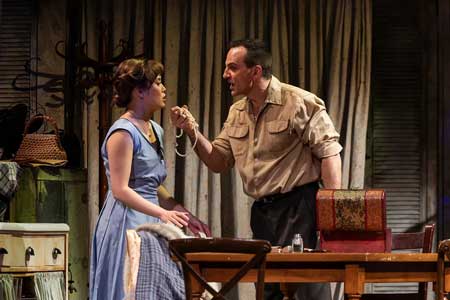
David Adam Moore as Stanley
in “A Streetcar Named Desire”
Photo: Nile Hawver/Nile Scott Studios
Courtesy of Boston Lyric Opera
Stanley (David Adam Moore) and Stella (Angela Yam) Kowalski are living in a modest apartment in New Orleans. Stella’s sister, Blanche DuBois (Brittany Renee), comes from Mississippi, unexpectedly, for a visit, and winds up staying. Stanley, a blunt and brutal guy, is none too pleased about it, but does not stand in the way of Blanche meeting his card-playing buddy Mitch (Brenton Ryan). Blanche and Mitch begin to see one another, offering some hope to Blanche for a permanent arrangement, but things get sticky. In digging about the inheritance of the family estate, Stanley finds out some things about Blanche that are less than wonderful, and this serves to screw things up between Blanche and Mitch. Things get pretty dicey in the end. (See Spoilers section for more.) Blanche does leave, finally, with the iconic words from the play: I have always relied on the kindness of strangers.
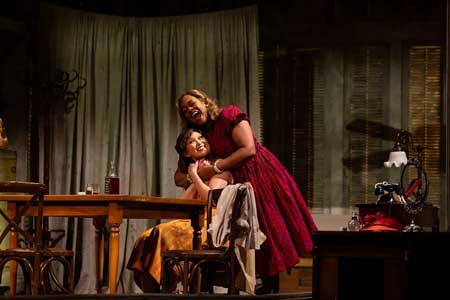
Brittany Renee as Blanche
in “A Streetcar Named Desire”
Photo: Nile Hawver/Nile Scott Studios
Courtesy of Boston Lyric Opera
André Previn’s music is engaging, lively and lyrical enough to keep one’s attention throughout the course of this searing drama, but it does so mostly as musical landscape. That, in itself, is not at all bad in this case in which dramatic voices rise above the melange of sounds which inform Previn’s score and which evoke, effectively, the dark, urban and seedy New Orleans background that forms the dramatic substrate of the action.
During the first half, Previn’s music, though illuminating and interesting, strikes one as pastiche, as a collage-like wash that has subsidiary melodic elements that certainly flow into one another but which, in toto, form a background. In the second half, as the drama unfolds, the music, though not essentially changed in character, appears to infuse and blend with the voices – particularly that of Brittany Renee’s Blanche – in a way that is particularly effective and moving. It’s an interesting alchemy, not particularly delineable by the techniques involved, but one that is notable and penetrating.
The earmark of much great tragic drama is the curiously subtle way in which the network of complications grow to a point of irresolvable tension. When that is achieved, a weighty atmosphere infects the stage, transcending character and circumstance in achieving something persuasively post-verbal. That quality, certainly exhibited in Tennessee Williams’ great play, provides a wonderfully suitable template for operatic treatment. Littell’s libretto and Previn’s score deftly allow that tragic fruition to come through, and the means by which they do so is subtle rather than heavy-handed. Littell’s words relate the story but do not go over the border into melodrama, and Previn’s score does much the same, by providing texture and climate with some punctuation, but not in a way to obscure the dramatic action itself.
The music bears interesting thematic elements, including certainly some hints of an urban New Orleans flavor, but also of an urban flavor in general, not unfamiliar in tone and texture to elements of Bernstein’s score for West Side Story. As well, there are swaths of Americana woven in, with pieces that echo with some familiarity from Copland’s Appalachian Spring. These are thematic influences, but not carried over wholesale certainly, and demonstrate Previn’s capacity to make use of prevailing American musical influences. Certainly, both Copland and Bernstein were eclectic in their own compositions, and this quality in Previn follows in that noble tradition.
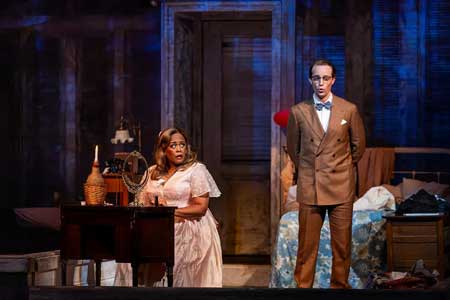
Brenton Ryan as Mitch
in “A Streetcar Named Desire”
Photo: Nile Hawver/Nile Scott Studios
Courtesy of Boston Lyric Opera
All the singers here are worthy of note, with Brittany Renee’s Blanche as the standout. Her voice is rich and contralto-like, with deeply sonorous tones, which make her evocation of the main character’s pathos moving and affecting. Angela Yam as Stella has a rich but somewhat tighter voice, but is very effective in the role. And, as Stanley, David Adam Moore is deeply and boisterously unsettling, with a strong voice to boot.
As Mitch, Brenton Ryan is quietly but lyrically illuminating, and his and Blanche’s movingly sung second act scene may be the heart and soul of the production. Interestingly, that tender core of the failed courtship in Williams’ other masterpiece, A Glass Menagerie, struck me as particularly significant, especially in the fine production done at the Gloucester Stage in 1995. In this core scene in Streetcar, that subtle but poignant drama is additionally supported by Previn’s quilt-like but illuminating score which particularly comes into its own in this scene.
The set by Andrew Boyce is textured and interesting, and lighting by Eric Southern and projections by Kylee Loera are particularly well done, embellishing the sense of the busy urban landscape. The orchestra is in fine form, led ably by Daniela Candillari.
– BADMan (aka Charles Munitz)
Leave a Reply