Interview
On November 5, 2026, I interviewed Anna Slate, star of Blackhollow, who plays twelve different characters in the Gothic thriller in production at the Greater Boston Stage Company in Stoneham, MA running from October 23 – November 8, 2026. An edited transcript of our conversation follows.
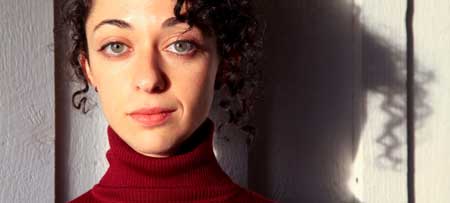
Photo: Courtesy of annaslate.com
(AS: Anna Slate, CM: Charles Munitz [aka BADMan])
CM: I loved your performance. I thought it was just so well done and, largely because of your great performance, that it was quite easy to follow the somewhat intricate plot with so many different characters. I can only imagine what it must have been like to act it. Tell me a little bit about your process for creating these twelve characters, developing the dialects, and all the different aspects of it.
AS: Most of the characters I found pretty early on. Lucy really feels mostly like me. I don’t have time to develop a whole new person for every role. She’s the anchor. She’s kind of my core.
Weylin’s (Weylin Symes, author of “Blackhollow”) language helped me intuitively find the ethos of each character. I’ve done a couple of one-person shows before, and I tend to work from the outside in. What is the shape of this person? What is the coat I’m putting on for each one physically, vocally, facially, technically? That helps me trigger the transitions more quickly. If I’m assuming a new position for each person, everything else falls in line. I started with larger archetypes of different types of characters and then whittled away from there to make them more specific than simply the dubious doctor or another stock type.
It all came pretty quickly for the most part. In terms of keeping it legible for the audience, there are so many words. A huge part of it for me as the actor was asking: if I have five sentences describing one action, where do I place the actual physical action so it creates the most impact?
If I’m describing someone being stabbed, I may have three to five sentences leading up to that. Where does the action happen so it reads most clearly? Because it’s such a thriller, we want the punch. How do the action and the narration work together to create the most physical shock, impact, or clarity?
Beyond that, it was really about going through the script and distilling each moment. What’s the most important part of this section? What is the audience learning in this moment? How can I vocally highlight that so it comes through as clearly as possible?
Weylin and I would talk about that constantly. We’d stop and ask: what’s the most important thing here? Then I’d find the words that resonated with me most strongly and emphasize them. In a show with this many words, it helps the audience know what to listen for.
CM: It seemed to really work because each character was distinct, and the sequence of events – except where I think Weylin was intentionally seeking some ambiguity – came through very clearly.
Tell me also about your work with Lee Nishri-Howitt (noted Boston-area dialect coach who worked with Anna Slate on this production) and the dialects. Your dialects were just perfect, and there were so many of them. It wasn’t a matter one bad English accent following another – there’s nothing worse than that.
AS: Lee is incredible. I’ve worked with him before in Leopoldstadt, which was a very different world. (Slate performed in the stellar production of Tom Stoppard’s last play at the Huntington Theatre in Boston in 2024.)
He was really helpful in giving me feedback about whether the cadence was different enough from character to character and whether the pitch and resonance distinguished them enough. It wasn’t just about dialects. It was about rhythm. Ashburn (the dastardly experimenter in “Blackhollow”) talks a little differently. He’s more legato. Trammell (the dastardly head nurse in “Blackhollow”) is much more staccato for me. Finding the rhythm and cadence of each character was a huge part of the work. Lee was also helpful in identifying reference points and stock characters. For example, thinking about Maggie Smith for Trammell. Finding iconic figures I could listen to and emulate helped me get into those characters.
He also helped me understand where the language lives in the body, because the voice is not detached from what I’m doing physically. How is every aspect of this character communicating the same thing? Can the audience see it visually, hear it vocally, and feel it energetically? He was instrumental in helping me distinguish all those elements and, importantly, in making the whole thing sustainable – because it’s a lot of constant acting.
CM: What is your view, and maybe this is really a question for Weylin, but why a single person doing all of this?
AS: That is a question for Weylin. I know he thought about it as a two-hander at one point. I don’t know exactly what the final decision was. I think the more he sat with the words and discussed it with Daniel Begin, the co-director, the more they felt it would be interesting as a one-person show.
What I find most exciting is that the play deals with possession and with the melding of personalities. Since it’s only me onstage, I get to play with that idea directly. I want each character to be as clear as possible, but then there are moments when I want things to become less clear. Wait, who’s speaking now? Do all these people live inside Lucy? Does she invent them? How do we absorb other people into ourselves? We’re social creatures. We’re constantly picking up one another’s mannerisms. A one-person show allows you to establish a clear form and then later start playing with that form. Toward the end of the show, I want audiences asking themselves Wait a minute. Was that Ida speaking or Lucy? That’s really the ethos of the show. It’s what the play is about.
CM: It really works with you doing it. How did you come to this role? What was your connection with Greater Boston Stage and with Weylin?
AS: I’d worked with Daniel Begin before. I had just done Charlotte’s Web the previous season. (Begin was the Associate Director of that production of “Charlotte’s Web” at Wheelock Family Theatre in the spring of 2026) Daniel called me in to audition for this. Maybe I shouldn’t even tell you this, but I showed up not realizing it was a one-person show. I had looked only at Lucy’s lines. Then they said, “And?” and I said, “What?” They basically surprised me with it in the audition room. But I kind of loved that. I have a background in clowning, so I just thought, Let’s go for it. I started improvising different characters on the spot, and somehow it worked. It was thrilling. This was my first time working with Greater Boston Stage, though I’d auditioned there before. I was very honored to be offered the role and trusted with it.
CM: You’ve done so many different types of things, both in theater and musical theater, in singing and beyond. Give me a sense of where you’ve been, what’s happened with you, and how it has shaped who you are as an artist.
AS: I’ve had a somewhat unusual path. I started out singing opera, specifically early music. I also worked in contemporary classical music. After college, I followed that path for a while and was fortunate to be involved in some really wonderful productions. At a certain point, though, I realized that every time I did something singing-heavy, people would say, Wow, you’re such a great actor. And whenever I did acting work, people would say, Wow, you’re such a great singer.… which is wonderful to hear, but it also left me trying to figure out my artistic identity. I ended up taking a roundabout route, following whatever felt most interesting. I never formally studied acting. I was always fascinated by music and sound, and that still informs everything I do as a performer.
For me, everything is vocal. I’m taking my opera breath and finding as much resonance as possible. That’s extremely important to me. More broadly, though, I’m interested in authentic storytelling. That’s not genre-specific. I would go see Pina Bausch any day of the week. The specificity of movement is incredibly important to me as a performer. I’m interested in work that is deeply specific while still being expansive. That’s what excites me artistically.
CM: I gather that one of your inspirations is Meredith Monk.
AS: Yes.
CM: That’s pretty wild stuff.
AS: I love her. I did a workshop with her and was involved in callbacks for one of her projects. That kind of storytelling, incredibly specific and incredibly abstract at the same time, is something that really excites me. I’ve been fortunate to encounter that balance in many different genres. I like challenging myself. I make decisions largely based on who I’m excited to work with and what material feels alive to me.
CM: I saw also that you did a show about hair. Around that period I was living in New York and continuing to do opera. I worked with Heartbeat Opera, which remains one of my favorite opera companies. Over time, I realized I wasn’t feeling compelled to continue purely as an opera performer. The same thing happened with straight acting. Both were exciting, but neither felt like the complete picture. So I took a class with Judy Gold on solo writing and solo performance. That’s where I began mining my own history and experiences as material. That’s really where I found my voice as an artist. I discovered how to combine campy humor with deep vulnerability and personal truth. Bringing those different voices together into a form that feels authentic to me was incredibly empowering. I’ve now written several solo works.
CM: Have you performed them all?
AS: Yes. The piece about body hair is called Hirsuit. I performed that at a festival in Michigan this summer. I also wrote a piece about my grandmother, who died during the pandemic in New York City. I performed that at the Providence Fringe Festival. Those are the two major solo pieces I’ve done so far. And once this production ends, I’m going to start working on a puppet piece about hermit crabs for young children.
CM: I also noticed you played Anne Egerman in Stephen Sondheim’s A Little Night Music (1973). That’s a fascinating role.
AS: It is. I did that right out of college when I was living in Wisconsin. I was younger then and very much in soprano territory. Anne is a very natural character to play. She’s flighty, impulsive, and always somewhat caught between one thing and another. It was a very fun production.
CM: I also noticed you were in Romeo and Juliet with Lanes Coven Theatre, which is a company I love.
AS: Me too. Shout-out to Lanes Coven. Justin (Genna) and Lily (Narbonne) are wonderful. I had such a good experience working with them.
CM: He’s struck me as a talented director. (Genna directed Love’s Labour’s Lost in 2025.)
AS: Extremely talented. I told him afterward that I was so impressed with how efficient he was without sacrificing artistry. We didn’t have much time, and he knew exactly how to run the rehearsal room. He gave actors room to explore while also leading the process with tremendous clarity. I was really impressed.
CM: What about clowning? Where does that fit into your work?
AS: That’s a great question. It finds its way into almost everything I do. For me, clowning is fundamentally about freedom. The clown is fearless. The clown is trying to connect. If I fall on my face onstage, that’s okay. That’s part of being human. That freedom has been enormously valuable to me as a performer. In a show like this it’s a little trickier because if I forget a word, there aren’t many places to hide. But when things go wrong, that’s when my clown training really kicks in. The biggest influence is probably in my self-created work. That’s where I most consciously draw on clowning.
CM: What’s next on your horizon? It seems like you’ve got so many things going on. What would be your next project, if you could choose it?
AS: I do have a couple of plays lined up for the season. Before I jump into those, though, I’m going to dedicate time to developing my hermit crab piece, which I’m very excited about. It’s a project that’s very dear to me. I love tiny creatures, and after carrying such a huge lift in this show, which has been amazing, I’m looking forward to settling into something a little quieter. I want to return to my own voice and spend time writing and researching. I work with very young children, and creating theater for them feels especially exciting. I enjoy tactile, participatory theater where the audience gets to co-create the story. That’s another place where my clown training comes into play, and it connects deeply to my work as a teacher. After that, I’ll be understudying Mother Russia at Trinity Rep, which I’m very excited about, and then I’ll be appearing in Indecent at Umbrella Arts.
CM: I noticed that you’ve done Indecent before.
AS: Yes. That production was in Providence.
CM: Was that you playing the violin?
AS: Actually, it was viola.
CM: You’re a violist as well?
AS: I played viola in high school. One of the reasons I was excited by Indecent is that Katrina Lenk <star of the 2017 Broadway production) was originally a violist. In the original production she had a wonderful moment playing with the violinist, who was also deeply connected with the Klezmer world.
CM: I saw that production in New York.
AS: It took my breath away. It’s an extraordinary piece. I played the Younger Woman in that production, and this time around I’ll be moving into the middle role, which is exciting.
CM: Tell me a little about your interest in Jewish music and your work as a cantor.
AS: I know some people in my hometown in Connecticut who are deeply involved with a Humanistic synagogue. While I was living in New York, they asked me if I would be interested in coming in as a song leader. It was a complete no-brainer. I still do that work, and I also sing church services and chamber music engagements. But for the synagogue work, it’s really about serving as a musical leader and helping create a meaningful communal experience. I love it. A large part of what motivates me artistically is being of service. If I can help hold people through moments of celebration, reflection, grief, or connection through music, that’s a really beautiful thing to be able to offer.
CM: You also have mentioned being a JuBu (Jewish Buddhist). What’s your connection with meditation and Buddhism?
AS: I first encountered the work of Tara Brach when I was in my twenties. Her book Radical Self-Acceptance really opened something up for me. As a somewhat neurotic Jewish person, I was looking for ways to work skillfully with anxiety. Tara’s integration of insight meditation and psychotherapy felt tremendously accessible. I attended a number of retreats with her, including silent retreats, and that practice has stayed with me. A lot of it comes back to the values that inform my work as a performer. Learning to relate to the voices in our heads without being consumed by them is incredibly valuable. The practices of spaciousness, perspective, compassion, and non-attachment have all become important anchors for me. Life can be confusing, and meditation has been a way to return to myself and to trust the process of living. A number of my favorite teachers and mentors have occupied that space somewhere between Judaism and Buddhism.
CM: Hearing you talk about your centering practice makes me think about this show. Blackhollow is obviously presented as a Gothic thriller, but you bring a remarkable amount of heart to it. Everything you’ve described about your artistic process seems reflected in the performance. Does that resonate with you? Does even a nineteenth-century horror story provide opportunities to explore those deeper questions?
AS: For me, this show is a meditation. It’s an hour and forty-five minutes long. Naturally, the mind wanders. I find myself wondering how the audience is doing, thinking about something that happened earlier, or drifting somewhere else entirely. My practice is continually returning to the present moment. In that sense, the show itself becomes a meditation. The words become the object of concentration. My task is simply to keep returning to them, to the specificity of the storytelling and the physical action. The experience becomes a kind of mental marathon. The question is always: can I return to what’s happening right now? That practice helps me remain available not only to the material, but also to the audience. If I’m present in myself, then I can be present to everyone else in the room and to the collective atmosphere we’re creating together.
CM: That’s fascinating. And you mentioned your opera breath earlier. Breathing is such a central part of meditation as well. Could you say a little more about the role breath plays in this performance?
AS: The breath brings me back into my body. It helps me remember words. It supports thought. It supports character. One thing I’m very conscious of in this production is a sense of chiaroscuro, the interplay between light and darkness. Different characters inhabit different tonal worlds. Lucy (the protagonist of “Blackhollow”) and Ida (the experimental subject in “Blackhollow”) are a good example. Lucy occupies one register of energy and resonance, while Ida exists in another. Moving between them involves shifts of breath, placement, color, and mental state. Those distinctions may not be consciously noticeable to the audience, but they’re deeply important to me. I also try not to limit characters by keeping them locked into a particular vocal register. A character may generally live in one place vocally, but when emotion changes, the voice changes too. That’s true of real people. So resonance, breath, and vocal flexibility become tools for sustaining the storytelling and preserving the individuality of each character throughout the piece.
CM: It’s an amazing performance, Anna. Hearing about the techniques that sustain it night after night only makes it more impressive. Thank you for spending this time with me. It’s been wonderful hearing about your work, your artistic journey, and the thinking behind the performance.
Leave a Reply