Play (1959)
by Eugène Ionesco
Translated by Derek Prouse
Adapted by American Repertory Theater
Directed by Diane Paulus
American Repertory Theater
Loeb Theater Center
Harvard University, Cambridge, MA
August 14 – September 27, 2026
Scenic Design: Riccardo Hernández; Costume Design: Anita Yavich; Lighting Design: Jen Schriever; Sound Design: Fitz Patton; Special Effects Design: Markus Maurette; Hair & Wig Design: Tom Watson; Make-up Design: Kyle Krueger
With John Turturro (Berenger), Paul Giamatti (Jean), Tatiana Maslany (Daisy), Peter Francis James (Grocer/Papillon), Kristine Nielsen (Grocer’s Wife/Mrs. Boeuf), Alex Ross (Dudard), Clay Singer (Botard/Waiter), Harriett D. Foy (Housewife), David Mason (Understudy), Amelia Sipkin (Understudy), Scott Stangland (Understudy), Britt Faulkner (Understudy), John Kuntz (Understudy)
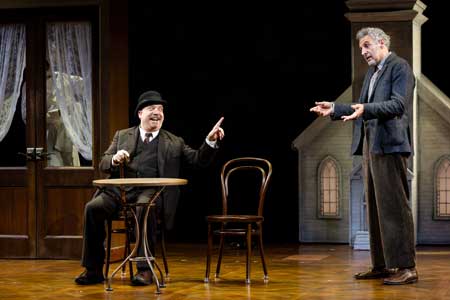
John Turturro as Berenger
in “Rhinoceros”
Photo: Hawver and Hall
Courtesy of American Repertory Theater
Berenger (John Turturro) and his straight-laced friend Jean (Paul Giamatti) are conversing; Jean is taking Berenger to task for his drinking. Jean is officious, Berenger is appealing but fragile, and it seems that Jean is the up and up guy trying to help out a friend in somewhat desperate need. Berenger confesses that he loves a younger co-worker, Daisy (Tatiana Maslany) but realizes that she is unlikely to be at all drawn to him when another co-worker, Dutard (Alex Ross), younger and more handsome, is the more likely catch.
We see Berenger, disheveled and at loose ends, sneak into a company meeting, led by officious owner-boss Papillon (Peter Francis James), where the company is gathered. Botard (Clay Singer), in particular, holds forth on nothing special but forcefully and distinctively, and we get a gander at Daisy, Dutard, and Papillon, among others. Boeuf, another employee, is missing unexpectedly and without explanation until Mrs. Boeuf (Kristine Nielsen) rushes in with the report that her husband has turned into a rhinoceros.
Gradually, things develop, and, in another meeting between Jean and Berenger, Jean begins to develop a horn, grunt and demonstrate all the qualities of his burgeoning rhinocerosness. In short order, we learn that almost everyone besides Daisy and Berenger have turned into rhinoceri, and in a few final scenes we see them expressing affection and commitment to one another. But will it last? And will they resist the temptation to join all of the others? (See spoilers section below to find out.)
What a terrific production this is! John Turturro is out of this world as Berenger, creating a sense of a character daunted and overwhelmed, but deeply, though perhaps unconsciously, principled, spot-on, precise moving and in his portrayal of the central character. Paul Giamatti, as well, gives a robustly attentive rendition of his more eventually histrionic character, managing to move from the uptight bureaucrat to the fuming rhinoceros without batting an eye. Both of these noted film actors are also superb stage actors, nuanced, finely attuned, expressive and completely on point. And they work brilliantly well together.
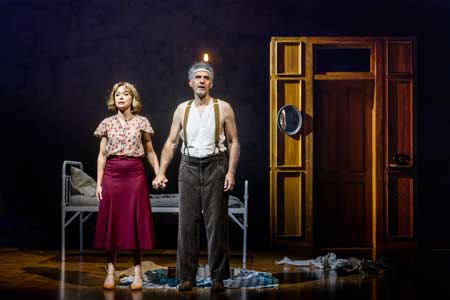
John Turturro as Berenger
in “Rhinoceros”
Photo: Hawver and Hall
Courtesy of American Repertory Theater
Diane Paulus’ adept direction is notable throughout, as evidenced by not only the resounding performances of the two lead actors, but also by the cast as a whole. As Daisy, Tatiana Maslany gives a dramatic and articulated interpretation, enabling, especially in her interactions with Turturro’s Berenger, a sense of an unexpectedly forthright and idealistic romantic partner, and of a character teetering on the edge of collapse. Peter Francis James’ Papillon is appropriately rigid and declamatory as a bossy boss should be, and Clay Singer’s Botard is not far behind in a rhetorically demonstrative and over-the-top display. And, keeping with the rhythm of exhibitive gestures, Kristine Nielsen’s Mrs. Boeuf is at once demure and hysterically amplified. Alex Ross, in a more subtle role as Daisy’s presumptive paramour Dutard, makes his own case forcefully. And, along with Giamatti’s Jean who does the same taken under the sway of the jungle in overwhelming release, Dutard removes his shirt and bares his chest.
The staging is also excellent, with the ART’s range of resources used judiciously and wisely to great effect. Notably, the sound design by Fitz Patton offers the growling under and over tones of the growing herd very adeptly, with enhanced and duplicated voices emphasized with lurking significance. Scenic design by Riccardo Hernandez and lighting by Jen Schriever are also very well done, again without overwhelming the scene of the action. Simple though evocative, the set offers, in the second act, an elaborate macrame of entangled bed frames, evocative of the madness that has ensued, which arches over the back of the stage, a simple but eloquent touch.
The new ART adaptation of the original English translation by Derek Prouse gives the show robustness and contemporary feel without being slangy or too comfortable in inappropriate idioms.
Ionesco’s tragicomedy, written in the late 1950s and clearly an allegory about the growth of authoritarianism in his native Rumania, is beautifully crafted, with a simplicity of outward form which makes its message clear while giving room to great actors like Turturro and Giamatti to have their ways with it. It provides a wonderful template for their onstage interpretations, which terrifyingly evoke the sense of a growing epidemic of irrationalism, painfully quite relevant at the current moment.
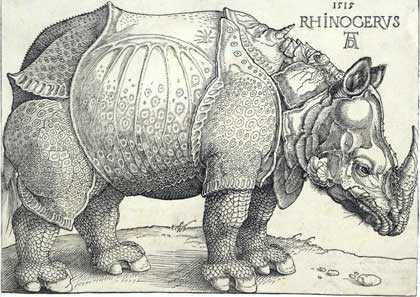
by Albrecht Dürer
According to director Diane Paulus in some comments at a celebration after the show, John Turturro had originated the idea of this production and, when Paulus heard of his interest, jumped on doing it with him. It’s wonderful that she was able to realize this vision, to bring in another notable talent like Giamatti, and to mount an excellent supporting cast.
The production is one of a few other very nice Ionesco productions in the Boston area this year, including Arlekin Players’ Theatre’s superb Delirium, an interpretation of Frenzy for Two, or More (Délire à deux) (1963) in June, and Hub Theatre’s The Bald Soprano (1950) and The Lesson (1951) in February. Ranging from the purely absurdist to the definitively allegorical, these works evoke a vivid sense of the times, then and now, and the psychological effects of living in a period of considerable confusion, alienation and anarchy. Kudos to Paulus, to the ART and these other excellent theatres for helping to bring Ionesco’s hilariously uncomfortable visions to us in times of trouble.
Overall: Excellent, on all scores.
– BADMan (aka Charles Munitz)
Leave a Reply