Play (2018)
by Aaron Sorkin
based on the novel To Kill a Mockingbird (1960) by Harper Lee
Directed by Loretta Greco
Huntington Theatre Company
Huntington Theater
Symphony Hall area, Boston
October 8 – November 8. 2026
Scenic Designer: Andrew Boyce; Lighting Designer: Christopher Akerlind; Voice and Text Coach: Ashleigh Reade; Assistant Director: Sarah Oakes Muirhead; Costume Designer: Celeste Jennings; Sound Designer: Daniel Baker; Wig, Hair, Makeup Co-Designers: J. Jared Janas, Cassie J. Williams; Production Stage Manager: Kevin Schlagle; Stage Manager: Lauren J. Burke; Stage Manager: Kendyl Trott; Stage Manager: Athéna-Genesis Baptiste; Dramaturg: Charles Haugland
With Karl Kenzler (Atticus Finch); Rafael Jordan (Tom Robinson); Karen Killeen (Scout); Benjamin Izaak (Jem); Patrice Jean-Baptiste (Calpurnia); Andrew Stevens Purdy (Dill); Liam Craig (Bob Ewell); Jesse Garlick (Horace Gilmer); Ken Cheeseman (Judge Taylor); Michael Poignand (Sheriff Tate); Jackie Scholl (Mayella Ewell); Lewis D. Wheeler (Bailiff, Dr. Reynolds); Jesse Hinson (Mr. Cunningham, Boo Radley); Aimee Doherty (Miss Stephanie, Dill’s Mother, Mrs. Dubose); Kyle Cameron (Link Deas); Ashley Frith (Musician, Composer); Ensemble: Liam Delaney, Wyatt Anton, Bob Gallagher, Raissa Karim, Zach Kautter, James Ricardo Milord, Cameron Mysliwicz, Alex W. Pollock, Scott Salley, Will Sheerin, Joanna Strapp
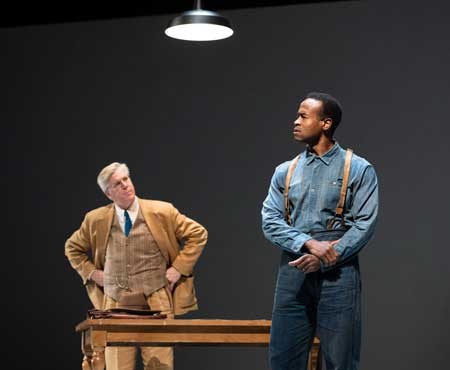
Rafael Jordan as Tom Robinson
in “To Kill a Mockingbird”
Photo: Liza Voll Photography
Courtesy of Huntington Theatre Company
Atticus Finch (Karl Kenzler) is a lawyer who is appointed to defend Tom Robinson (Rafael Jordan), a black man accused of raping a young white girl, Mayella Ewell (Jackie Scholl), in her home. The girl’s father, Bob Ewell (Liam Craig), a dissolute racist, is out to get Robinson, and appears, himself, to have been the perpetrator of the crime. Robinson is brought to trial with the reasonable Judge Taylor (Ken Cheeseman), but is confronted by an astute prosecutor, Horace Gilmer (Jesse Garlick), and an all-white male jury. (To find out what happens in the trial, see the Spoilers section below.)
The tale is narrated by Scout Finch (Karen Killeen), Atticus’ young daughter, who pals around with her brother Jem (Benjamin Izaak) and their friend Dill (Andrew Stevens Purdy). The kids watch the trial and eventually have other dealings which enter into the enveloping plot. The mysterious Arthur “Boo” Radley (Jesse Hinson) hovers on the sidelines, but also plays a role in these dealings as things progress. (See Spoilers section for more.)
The novel on which this play is based was a huge bestseller in the 1960s when it came out and has sold well ever since, considered by now an American classic. The celebrated 1962 film of the same name based on the novel, starring Gregory Peck as Atticus Finch, helped to solidify the image of Atticus as an American hero – resolute, steady, full of moral depth without being preachy. That performance has stood for over sixty years as a landmark of American film heroism.
Sometime in the last decade, the well-known television and film screenwriter Aaron Sorkin, particularly noted for his masterful contribution of the series The West Wing, decided that something in the depictions in To Kill a Mockingbird needed revisiting. Apparently, to Sorkin, Finch, as shown in the novel and in Peck’s embodiment in the film, is too angelic, that there was a need to make him more human and down-to-earth. As well, it appears that Sorkin felt that the black characters in the narrative – Tom Robinson, and Calpurnia, the Finch housekeeper (Patrice Jean-Baptiste), needed more of a voice. Hence, Sorkin’s dramatization appeared, and had considerable success when it arrived on Broadway with Jeff Daniels in the title role, and on tour with Richard Thomas in that role.
Sorkin has, indeed, achieved his goal in this new dramatization, on both scores. The Atticus Finch character is certainly less angelic. In this play, he is prone to a couple of outbursts which come almost out of nowhere, which indeed do indicate his unpredictable emotional vulnerability. Though morally steady, as in the past depictions, Finch, in this play, becomes a bit preachy, especially at the end when he is speaking in the interest of his son. (See Spoilers for more.)
All in all, Finch comes across here, rather than as the noble knight, as a well-meaning, but somewhat stumbling, character whose earnestness gains him some points while his self-righteousness, at other times, takes those points away. We come out thinking of Atticus not so much as a hero as a decent guy who has some trouble keeping it together. Certainly, at the end, when Atticus, Judge Taylor, and Sheriff Tate (Michael Poignand), come together to discuss what has happened, it seems that Finch’s moral standards get tested (see Spoilers). It is not very clear, in Sorkin’s retelling, whether any interesting advance has been made on the original regarding the quality of that moral outcome. Somehow, given Sorkin’s astute capacity for narrative and ripping dialogue so evident in The West Wing, one might have expected more.
Certainly, the two black characters have more of a say here. In an eloquent speech, beautifully delivered in a heavy but wonderful accent by Rafael Jordan as Robinson, there is a clear account of the plight of the wrongfully accused. It is heartfelt and heartbreaking. In a separate speech about the outcome of the trial, Patrice Jean-Baptiste as Calpurnia also speaks eloquently and wonderfully, in a more wry and objective assessment of the state of racism and what it means to live with it and under it. It is clearly and thoughtfully delivered, a stark but important complement to Robinson’s painful outcry. These two speeches, in many ways, represent the high points of this play and of this production.
It’s not clear exactly what Sorkin might have done to embellish the roles of the three children, but they seem, in this play, to do a lot of running around. Clearly, as Finch’s children, Scout and Jem have a central role. It’s not clear what their friend Dill adds to the mix, nor how Sorkin might have envisioned that role in this retelling. Some of this kid activity gets a bit intrusive, but it appears that Sorkin has decided to maintain it more or less as it was; the direction of this production seems to maintain that as well.
There’s an odd introduction of the all-white male jury at the beginning, but they are removed for the remainder of the trial, though their chairs remain. It’s a curious alteration, though one could certainly see that having those twelve guys sitting there for the duration of a courtroom drama might be a bit wearing for all involved. Nonetheless, because there was no indication of what was going on as the trial proceeded without the jury, I kept wondering where they were.
As Atticus, Karl Kenzler gives a portrayal that emphasizes the daunted quality of the character, admixed with an earnest moral intention, and that combination comes across well, which seems to realize Sorkin’s intention. As Judge Taylor, long-time Boston actor Ken Cheeseman does a fine job, giving a very human twist to the role. As the prosecutor, Horace Gilmer, Jesse Garlick also does a fine job, conveying a chilling sense of foregone injustice accomplished. In the role of Tom Robinson, as noted, Rafael Jordan maintains a dignified bearing throughout, and then speaks, during a long soliloquy, with passion, verve and a memorably compelling demeanor. As Calpurnia, the housekeeper, Patrice Jean-Baptiste is elegant, wry, forceful and also wonderfully, unsettlingly, to the point. Liam Craig is perfectly and appropriately creepy as the unsavory Bob Ewell.
– BADMan (aka Charles Munitz)
Leave a Reply