Film (2026)
Written and directed by Giuseppe Tomatore
A Brunello Cucinelli SPA and Masfilm Production
In collaboration with Rai Cinema
Music: Nicola Piovani; Director of Photography: Fabio Zamarion; Film Editing: Massimo Quaglia e Pietro Foglietti
With Saul Nanni (Brunello, adult), Francesco Cannevale (Brunello, age 7), Francesco Ferroni (Brunello, age 15), Emma Fatone (Federica), Beatrice Carlani (Mother Maria), Matteo Calderini (Father Umberto)

Photo: Stefano Schirato
Brunello Cucinelli grew up in a poor farming family in Umbria, Italy, and moved with them to Perugia where his father got a job in a factory. Unfortunately, the move was not a happy one for his father, who despaired over the inhumanity of his new work conditions. The sadness of that move impressed itself upon the young Brunello who was sharp, aware, and likeable. Though Brunello was not destined to see through a college education – he began but survived only a short while – he developed an interest, as a young man, in philosophy, especially with regard to social good and humanistic ends.
A talented card player and an astute gambler, Brunello made his way by playing cards until his mid-twenties, when, after falling in love and marrying Federica, he got drawn into his wife’s new clothing business. He developed an earnest interest in producing a distinctively and vividly colored line of cashmere sweaters which, quite remarkably, began to sell like hot cakes. One thing led to another and Brunello’s business grew. As it did, Brunello kept in mind two distinct influences – the sense of peace and harmony that derived from his early family and community life on the farm with its peaceful natural rhythm, and, as well, the earnest feeling that one could overcome the sorts of indignities that his father experienced as a factory worker.
As Brunello’s business and factory grew, it was clear that he was intent on making lives of his workers reasonable and pleasant. At lunchtime, the lights go down so that everyone could eat together. Factory floors are full of windows and exposed to the outside and to natural light, and there is a pleasant and appreciative attitude to all who work there. Though a business success, Brunello seems bent on the good life not only for himself but for all of those who work for him. The final scene of the film shows employees sitting at an unbelievably long table stretched out on a rural clime, eating and celebrating together, a tribute to the sense of collectivity and generosity cultivated in Brunello’s company.
This partially dramatized biopic is endearing in all sorts of ways. It depicts Brunello’s development from youth onwards, with actors, at various stages, portraying him. Most striking are the scenes when, as a young, long-haired, teenager and twenty-something, he frequents his favorite bar and plays cards for money. The astuteness which he exhibits as a master gambler is depicted throughout the film as exhibitive of the character trait which made him so successful. As well, he is portrayed as incredibly charming, genial and likeable, getting on with everyone at the bar and engaging all different types in banter and companionship. In one sweet set of scenes, he is shown nurturing the friendship of a developmentally developed young man who frequents the bar. All in all, Brunello seems like a clever, sharp, likeable and charismatic mensch.
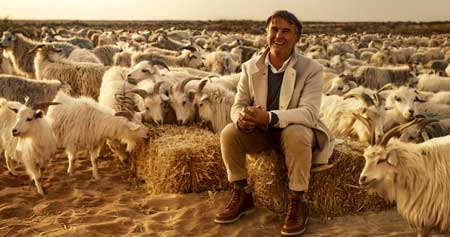
Photo: Stefano Schirato
His passion is also evident as he woos Federica, who would become his wife. At various points throughout the film, the actual older Federica weighs in, characterizing how unexpected Brunello was in all sorts of ways, loveable, unpredictable, hard-working and generally wonderful. As well, various of their grown children weigh in, giving a good sense of a devoted father as well as an astute and capable businessman.
Others, notable among them Oprah Winfrey, appear in cameo interviews to comment on Brunello’s charm and decency, and most of all, on his way of carrying out a humanistic form of capitalism. Everything he makes comes from the spirit of his soul says Oprah. This appears to be the central gist of the film, which is certainly a hagiography, but a likeable one.
There is a lilting quality to the whole production as it dramatizes Brunello’s history in a sequence of dramatized chapters, with a decent amount of thoughtful cinematography by Fabio Zamarion and an inventively lyrical soundtrack by Nicola Piovani. Certainly it is inspiring as a vision of what work might be, and an interesting depiction of a character who, though a bit of a youthful rogue, caught enough of the philosophy bug to see how to infuse goodness into his recipe for success.
The film opens with a beautiful shot of fires heating wine buds in a large grove of vines at Brunello’s winery, dramatic and exhibitive of the sort of artistic license taken by director Giuseppe Tomatore throughout the production. The voiceover suggests the poetry of the scene: Fire is silence, a symbol of contemplation, romantic, poetic, soul-stirring. Fire has been my life. Indeed, the quietude of fire, its significance as a warm center in the rural clime, and a sense of closeness and protection it offers serve as inspiration for the film.
There are some wonderful shots of models showing off Brunello’s beautiful designs, offering a great sense of an Italian fashion maven in the midst of stylish success. With all of that, there is the feeling of a sensitive and interesting, though crafty, character, who took a liking to Kant’s philosophy and to the idea of a moral imperative which can guide individual initiative and help society to flourish from all angles. His example, which is clearly glorified in this nicely wrought but adoring portrait, seems like it has many admirable qualities . One might hope that some of the hugely successful oligarchs who populate the contemporary world might take a page from Brunello’s book and figure out how to bring craftiness and generosity into a closer companionship.
,
The film is indeed produced by Brunello Cucinelli, which makes it certainly something less than an objective portrait, but nonetheless a well-intentioned one. Of course, having Oprah’s imprimatur lends a lot of credibility to the appreciations, but one wonders how a more objective journalistic or documentary analysis might approach its subject. Generally, however, as a well-meaning message about business, success, craft and decency, this film carries a good amount of weight.
– BADMan (aka Charles Munitz)
Leave a Reply