Play (1978)
by Harold Pinter
Directed by Shana Gozansky
Gloucester Stage Company
Gloucester, MA
July 9 – August 1, 2026
With Liza Giangrande (Emma), Michael Underhill (Jerry), Tanner Efinger (Robert), Jeremy Beazlie (Waiter)
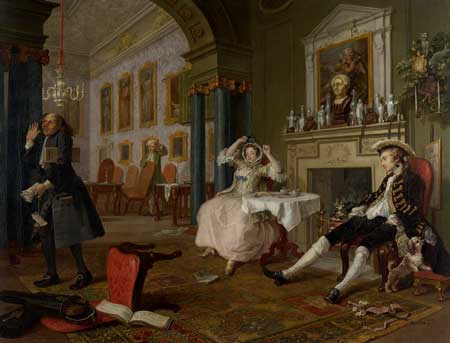
Marriage a la Mode: Tete a Tete (1743)
Courtesy of National Gallery, London
It is 1977 and Jerry (Michael Underhill) and Emma (Liza Giangrande) are getting together for the first time, two years after their seven year affair has ended. It gradually becomes apoarent that Jerry is friends with Robert (Tanner Efinger), Emma’s husband, and that they are engaged together in the publishing field.
Emma tells Jerry that she has just told Robert about their affair. She also acknowledges that she is having an affair with Casey, a writer whom Jerry, as agent, represents, and whom Robert, as publisher, publishes. Later that day, Jerry and Robert meet and Robert tells Jerry that he has known about Jerry’s affair with Emma for four years, indicating that Emma lied to Jerry about that earlier in the day.
Time moves backwards a couple of years and we see Jerry and Emma deciding to give up the apartment they have shared to support their ongoing involvement. Moving backwards a couple more years, while on vacation, Robert discovers a letter from Jerry to Emma and learns of the affair.
After a few more past scenes depicting the affair and Robert’s and Jerry’s friendship, the scene moves back to 1968 when, at a party at Robert’s and Emna’s house, Jerry makes a pass at Emma and declares his love for her.
Harold Pinter is known for a particular style of playwriting filled with pauses. This is particularly evident in his classics like The Birthday Party (1957),The Caretaker (1960), andThe Homecoming (1964), in which fairly familiar domestic scenes are converted into hollowed-out existentialist dramas by virtue of the metaphysical alienation he cultivates, a good amount of which is conveyed by this technique. The effectiveness of this effort gained Pinter a Nobel Prize for Literature in 2005, clearly winning the hearts of an awards panel which felt that the general dislocations conveyed by Pinter’s dialogue exposed a profound revelation about the human condition.
In Betrayal (1978), Pinter uses the same technique, but in a somewhat more subtle way than in the earlier plays. The intermittent pausing has some of the same effect, with the sense that alienation is in the air and that nothing is quite right with the world. In the earlier plays, the sense is that dislocation is an essential part of the fallen world. Here, in Betrayal, the sense is that corrupted trust in human relationship causes this deep sense of vacancy. It’s actually quite a shift in stance, and signifies an interesting development in Pinter’s dramatic arc.
From its appearance in the late 1970s, Betrayal has received multiple plaudits and is generally regarded as tightly written and well wrought. The subject-matter is actually taken directly from Pinter’s life – he carried on a years-long affair with Joan Bakewell, a British journalist, while he was married to actor Vivien Merchant. Later on, Pinter engaged in an affair with writer Antonia Fraser, to whom he was eventually married in `980 after divorcing Merchant. Pinter is no stranger to marital betrayal, from his own end. Bakewell, in commenting on Betrayal, has noted that the narrative of the play keeps very close to the story of their own affair, which is a curiosity in itself.
The actors in the current production in Gloucester are wonderful, and do bring as much as one can to this bizarre and sad play. Liza Giangrande (Emma) is a great actor generally, having given a world-class performance as Laura in Gloucester’s production of The Glass Menagerie last season. Michael Underhill (Jerry) is a dashing presence here, suitably geared up to be the classier alternative to dutifully less entrancing Robert, played with appropriate containment by Tanner Efinger. All three actors do a fine job, and the waiter, of course an oddly insignificant role, brings Jeremy Beazlie to the stage without any offense.
I hate to say it because this is, of course, Pinter, but I don’t necessarily see this as such a genius piece of dramatic writing. Indeed, the reverse chronology adds its own particular kind of drama to the sequences, and there is some shock value to the fact that everyone is betraying everyone in a variety of ways that becomes more obvious as things roll along. But there is nothing much in the way of character development or revelation in what happens, and mostly, the dramatic value is all locked up in the reverse-time revelations about how much lying has gone on throughout.
Nonetheless, this is a very competent production and all of the actors carry the grimness with their own form of style. Everyone speaks in some variant of English accent, but I’m not sure why that’s necessary; they all do a pretty good job of it, but, even so, this setup is not so dependent on these characters being English.
I remember seeing the well-received 1983 film adaptation with Jeremy Irons as Jerry, Ben Kingsley as Robert and Patricia Hodge as Emma. It was quite creepy, probably because Kingsley lent a particular form of containment to the role of Robert. Here, in this production, Tanner Efinger’s Robert is a little more transparent and one feels for him a bit more as a result. In the film, Jeremy Irons is, like Michael Underhill’s Jerry here, quite dashing, but Kingsley’s Robert complements that with a deeply nurtured anger that counteracts it. I remember one reviewer of the film identifying Robert as “evil,” which does not come through in the current production.
In any case, this is a good take on this later Pinter play which is more accessible than the earlier existential dramas, and which cooks its sense of alienation on the stove of human error instead of on the open flame of life itself. Good actors, and well worth seeing.
– BADMan (aka Charles Munitz)
Leave a Reply