Concert
David Finckel, cello
Wu Han, piano
David Shifrin, clarinet
Celebrity Series of Boston
Jordan Hall, Boston
January 15, 2016, 8pm
Trio in B-flat Major, Opus 11
Max Bruch
Four selections from ‘Eight Pieces, Opus 83’
Johannes Brahms
Clarinet Trio in A minor, Opus 114
Encore:
Johannes Brahms
Intermezzo, Op. 117, No. 1 for piano solo
(arranged for clarinet trio by Stephen Hough)
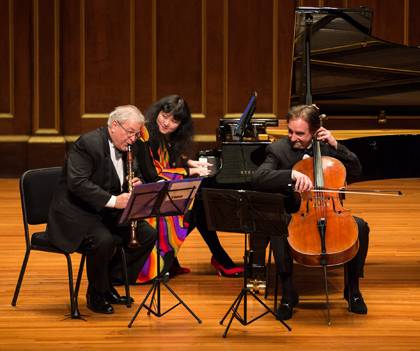
in a Celebrity Series recital
at NEC’s Jordan Hall
Photo: Robert Torres
Courtesy of Celebrity Series of Boston
In 1890, Brahms was near the end of his life and career – he died in 1897 at the age of sixty-four – and depressed as hell, feeling that he’d never write another piece, when he was suddenly inspired by meeting the clarinetist Richard Richard Mühlfeld to write two of his greatest chamber works. Those two late great pieces, the Clarinet Trio in A minor Opus 114 performed in this concert, and the transcendent Clarinet Quintet Opus 115, are hallmarks of the chamber music repertory. Thank God that Brahms met Mühlfeld and got inspired.
How curious that, so often, out of the depths of despair, some of the greatest artistic works appear. Other notable examples are, of course, van Gogh’s array of masterpieces that emerged during his confinement in Saint-Paul Asylum in Saint-Rémy, and Jackson Pollock’s iconic Blue Poles.
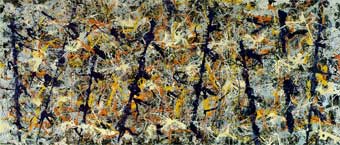
“Number 11, 1952,” also known as “Blue Poles”
National Gallery of Australia, Canberra
That late great Brahms trio work was the capstone of this program which featured, as well, an early clarinet trio by Beethoven and a series of pieces selected from a compendium by the late Romantic composer, Max Bruch.
Beethoven’s Trio in B-flat Major, Opus 11 is early and shows something of the straightforward classical influence that Beethoven exhibited during that period. It has its charms as a classical piece of that ilk while anticipating, in some of its forms, the later and greater Beethoven compositions. Its third movement is a series of variations, a form which Beethoven took on with some gusto throughout his career. Beethoven dedicated the piece to Countess Maria Wilhelmina von Thun, a great patron of the arts whom Mozart, according to the program notes, identified as “the most charming and most lovable lady I have ever met.”
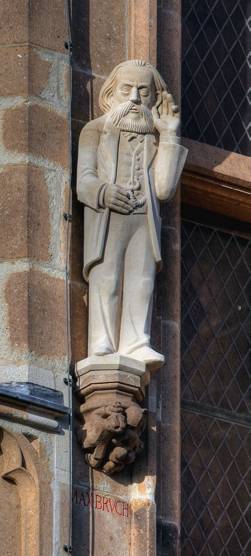
City Hall, Cologne, Germany
Max Bruch, who died in 1920, seven years after the famously violent premiere in Paris’ Théâtre des Champs-Élysées of Stravinsky’s The Rite of Spring, is best known for his early Violin Concerto No. 1 in G minor, Op. 26, a standard part of the virtuoso literature. As well, Bruch is known for Kol Nidrei, Op. 47, a cello piece inspired by the solemn opening hymn of the Jewish Yom Kippur service. As well as being in the standard cello repertory, it is widely performed in some synagogues at the evening service which opens Yom Kippur.
Bruch did compose a lot of other things besides the Violin Concerto No. 1 in G and Kol Nidrei, but none of them became anywhere as widely known as these two famous works, a source of considerable anguish for the prolific but somewhat overshadowed composer.
The piece included in this evening’s performance is a selection of four parts from Eight Pieces, Opus 83. Apparently, Bruch, like Brahms, had a particular clarinetist in mind when he composed these. In Bruch’s case, it was his son, also named Max.
David Finckel, cellist, and Wu Han, pianist, have played together for a long time and their nuanced and collaborative spirit is in full evidence. David Shifrin, the clarinetist, fit in the mix admirably and seamlessly. As an ensemble, their performance was gently modulated and poetic in its rendering. From the delightful interlaced runs of the Beethoven through the plaintive tones of the Bruch to the sculpted passions of the Brahms, they played with Apollonian modulation and subtle sophistication while maintaining a sense of warm appeal.
Notes from the performance –
Trio in B-flat Major, Opus 11
Allegro con brio
A measured approach to a lively opening. Delicate playing in transitional passages: beautifully clear fast runs. This is light Beethoven. A noticeably more subtle approach in the repeat of opening section – beautifully done! Light and supple piano, with declarative passages not too harsh. Love those echoing runs! Development section also in major key – a bit of a surprise until it builds to a development in the minor. Haunting, lurking arpeggios build to bold declaration of original theme, with a brief echo of that original theme in the minor key. Sforzandos are pressed but not punched – nice! The coda breaks into a charmingly playful tease at the end.
Adagio
A singing cello opening, which Finckel offers with measured grace, followed by Shifrin whose equally delicate approach delivers great gentleness. Wu Han’s lightly touched keys fill out the intro. A brooding development section yields dark and warm tones. Finckel and Wu Han weave together tonalities immersively in an internal duet, to which Shifrin adds with subtle highlights.
Tema con variazioni (on “Pria ch’io l’impegno”)
A jaunty opening! Wu Han’s liquid survey of the keys very much in evidence. Finckel oens a fugal interlude, sharing the festivities in delicate participation with Shifrin. When the clarinet breaks open the next section, it is with fire and verve. The piano introduces a meditative interlude, broaching pervasive quietude, out of which suddenly developsan energetic conclusion, but one which the adept trio shapes with moments of considerable delicacy. The earnest and guttural sequelae lead to a further series of variations, just the sort of light improvisations that Beethoven loved to explore at various points in his career. Wu Han’s persuasive piano pulls off a great syncopated coup leading the tow others onward to the delightful conclusion.
Four selections from ‘Eight Pieces, Opus 83’
VI. Nachtgesang (Nocturene): Andante con moto
Lovely opening sonorities in cello, with corresponding melody in clarinet play interestingly between major and minor keys. Finckel’s cello provides deep echoes with lovely surging tones. Again, the interplay of major and minor tonalities rises up, providing evidence of high Romanticism with a gently underlying warmth, while a plaintive Hebraic flavor is frequently in evidence. Are we really sure that Bruch wasn’t at least part- Jewish? Though apparently not, his music bears interesting traits of Jewish sensibility, even when not thematically drawn to it as in the Kol Nidrei. Some of the clarinet runs here sound like gently morphed versions of Klezmer music. A wonderful series of paired harmonic runs between cello and clarinet cap this sweetly plaintive opening.
II. Allegro con moto
Emerging with a sea full of waves from the piano, the cello then gladly rides upon them, calling forth. The clarinet returns the call as though from a distant island.
III Andante con moto
A long, ferocious intro by cello has almost a dark, Hispanic quality. The clarinet emerges out of nowhere in a soft, hinting tone. The piano presses from below, almost levitating the clarinet with Wu Han’s gentle touch. The return of the fierce cello, like a matador, emerges: serious, intent, passionate. And, finally, a return to the measured reflection of the clarinet, like a religious call, leading to the placid and delicate ending.
VII. Allegro vivace, ma non troppo
A scherzo-like opening from the piano is picked up by the other two. Suddenly this sounds more Classical than Romantic, a light, structured rebuff to the miasmic darkness which came before. It breaks into a playful, almost circus-like romp, and ends with a ferociously, fun poke in the ribs, uncharacteristic, in some ways, of some of that dark, moody seriousness which Bruch often offers.
Clarinet Trio in A minor, Opus 114
Allegro
A warm and lovely opening by Finckel and Shifrin with the immediately seductive, iconic theme, the cello swooping down in anticipation of eventual pianistic rumblings. A wonderfully textured cello interlude follows. Thorughout, it is so evident that Brahms knows how to use these tonal colors, making exquisite use of each instrument, with a clear sense of their collaboration! Recapitulation in a slightly more animated context leads to rumblings of doubt which follow in the transition (Brahms was, after all, coming out of a deep depression), and then on to a heavenly reflection before descending back into rhapsodically passionate pangs.
Adagio
The clarinet opens in a sweetly plaintive mode, yielding tonalities among the trio that blend and fuse in a hesitatingly probing, but lovely, way. A return to the originating theme without embellishments leads to an even more penetrating sense of yearning than initially. The trio adeptly shows its stuff as it bends, shapes, and feathers its approaches to the climaxes, always pressing a subtle sense of yearning amid what could easily become pathos.
Andante grazioso
A lyrical clarinet opens into an impressionistic interlude. Imagine a gathering by Monet’s lily pond, delicacy apparent everywhere.
Allegro
An intense and ferocious embarkation followed quickly by modulation shows interestingly how Brahms always mixes his moods – from intensely passionate to playful, to whimsical, to dark and reflective. This movement is a great example of that, a collage of sensibilities and tempers. But it all ends strongly, convincingly, its earnestness emerging almost from out of the blue, this adept and persuasive trio providing a durable embrace of conviction around an encyclopedia of emotions and sensibilities.
– BADMan
Thanks,I was not there but will try next time they play.
Your review with the additional cultural and historic additions is well done and very interesting.
Way above the usual critical reviews.
N.