Play (2013)
by Alan Brody
Directed by Andy Sandberg
The Nora Theatre Company
Central Square Theater
March 7 – April 28, 2013
Set Designer: Janie E. Howland, Costume Designer: Charles Schoonmaker, Lighting Designer: John R. Malinowski, Sound Designer & Original Music: Dewey Dellay
With Barlow Adamson (Major T. H. Rittner), Diego Arciniegas (Werner Heisenberg), Ken Baltin (Max von Laue), Owen Doyle (Kurt Diebner), Kendall Hodder (Erich Bagge), John Kooi (Karl Wirtz), Will Lyman (Otto Hahn), Ross MacDonald (Horst Korsching), Allan Mayo (Paul Harteck), Robert D. Murphy (Walther Gerlach), Dan Whelton (Carl-Friederich von Weizsacker)
It is hard to imagine any stage these days – except for those mounting Broadway-style musicals or children’s theatres – putting up a play with eleven members in the cast. But, here, for this stirring dramatization of an enforced sequestering of German physicists, eleven male actors have been commandeered and set into dramatic motion.
The drama of the play is subtle.
The ten physicists, managed by a British officer, Major T. H. Rittner, played with appropriate dignified restraint by Barlow Adamson, are holed up without exactly knowing why or for how long and this inevitably causes considerable tension.
The heightened frustrations they express reflect vividly against the obvious subtext, the taking of unwitting victims, mostly Jews, to concentration camps by the Nazis. That these physicists are the ones who remained in Germany and who, to one extent or another, collaborated with the Nazi regime, obviously magnifies this implicit comparison.
Some were Nazi party members, others not. Though one of the ten, Max von Laue (played with weighty import by Ken Baltin), had spoken out against the Nazis to some extent during the war, the others remained more or less silent, whether in tacit agreement with the Nazis or not.
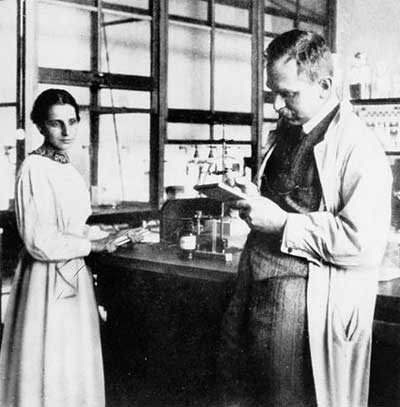
One, Otto Hahn, played with moving grandeur by Will Lyman, helped his Jewish colleague, Lise Meitner, to escape in 1938.
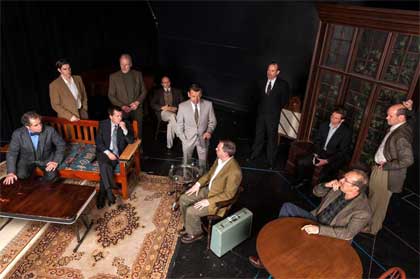
Photo: A.R. Sinclair Photography
Courtesy Central Square Theater
The question of intent of the great physicist Werner Heisenberg (Diego Arciniegas), father of quantum mechanics, takes on a central role.
Apparently, Heisenberg’s long-held miscalculation about requirements for a chain reaction led to a significant delay in the development of the German fission project.
The play suggests that Heisenberg’s mistake was an honest one, and that he himself sought to depict, after the war, that he subtly but willfully subverted the development in the interests of undermining the Nazis.
An alternative view, conveyed in Michael Frayn’s related play about Niels Bohr and Heisenberg, Copenhagen (1998), presents the foregoing account as, at best, uncertain, and that Heisenberg may well have intentionally subverted his research to derail the Nazis.
In Operation Epsilon, however, we see Heisenberg both as dutifully scientific, honestly confronted by the conceptual challenges posed by fission, and as Machiavellian, trying, after the war, to strategize about the best narrative to offer to the Allies.
There is a point at which all of the physicists break into song in a lighthearted and celebratory moment when one of them receives news he has been awarded the Nobel Prize. It is an interesting setup for the final moments of the play which are considerably different in tone, expressed through the reading of a letter that Lise Meitner writes to Otto Hahn after the war.
Ultimately, the contrast of robust celebration of intellectual accomplishment and the deep and painful echoing of moral failure and collective guilt resonates throughout the miscellaneous rooms of the mansion within which this intellectual tribe is confined. Believing they are intellectually pure allows the group to travel for some time with a sense of entitlement and indignation. When, in the final tragic notes of this artfully constructed play, they are confronted with the echoes of human suffering, any justifiable foundation of that assurance disappears.
The set within which this drama of confinement is staged (beautifully designed by Janie E. Howland), seems far larger and more extensive than its relatively modest footprint would suggest. It provides multiple spaces on different levels but shows an interesting rhythmic angularity while adeptly providing the functional dramatic requirements.
To convey the characters of such a large cast adeptly, as this production does, requires taut and disciplined playwriting, carefully attuned direction, and, of course, powerful and competent acting. All are well in evidence in this scientifically informative, historically interesting, and unexpectedly moving production.
– BADMan
Leave a Reply