Play (2012)
by David Adjmi
Directed by Rebecca Taichman
American Repertory Theatre
in conjunction with Yale Repertory Theatre
September 1-29, 2012
Scenic Design: Riccardo Hernandez, Costume Design: Gabriel Berry, Lighting Design: Christopher Akerlind, Sound Design: Matt Hubbs, Choreographer: Karole Armitage
With Fred Arsenault (Joseph/Mr. Sauce), Brooke Bloom (Marie Antoinette), Hannah Cabell (Yolande de Polignace/Mrs. Sauce), Andrew Cekala (The Dauphin), David Greenspan (Sheep), Vin Knight (Royalist), Jo Lampert (Marie’s Coterie), Polly Lee (Therese de Lamballe), Steven Rattazzi (Louis XVI), Jake Silbermann (Axel Fersen), Teal Sperling (Marie’s Coterie), Brian Wiles (Guard)
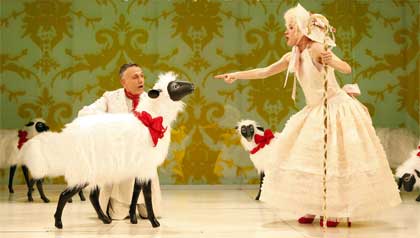
Photo by Joan Marcus
Courtesy of American Repertory Theatre
Set in the period just before and after the French Revolution, this play tells the fate of Marie Antoinette.
At the outset, before the Revolution, we encounter this rich and indulgent former Austrian Archduchess – who became the queen of France by marrying the distracted and ineffectual Louis XVI – at tea at Versailles with her companions, all of them wearing ludicrously funny, sky high wigs.
Through the course of the play, as the Revolution unfolds, Marie’s fate becomes compromised – and her hair much shorter – and, after living in hiding briefly, she faces the well-known historic consequences of her earlier pampered existence.
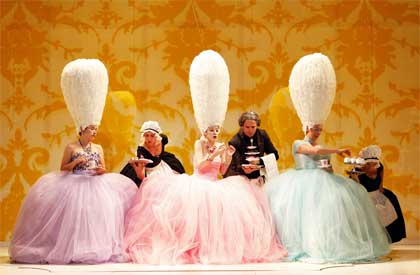
Photo by Joan Marcus
Courtesy of American Repertory Theatre
This play tells the historic story fairly straightforwardly, though it embellishes it with oddly inconsistent contemporary language. According to this rendition, Marie Antoinette (Brooke Bloom) cursed like a sailor and had a comedienne’s sense of irony and timing. Here, she seems more like a broad and ironically self-satirizing character of the sort played by Gilda Radner or Sandra Bernhard than a genuinely self-satisfied and pampered aristocrat.
This odd choice of characterization mixes with a narrative told completely from her point of view to render a peculiarly framed tragicomedy of manners rather than a more incisive critique of class difference.
Nonetheless, this production seems clearly and consciously intended, during election season, to bring to mind the grave current economic imbalances in the United States and to point up the kinds of self-deluded stances that some wealthy, so-called one-percenters, hold. The attempt is noble and the idea of framing the issue of economic injustice a good one.
However, on top of its odd directorial slant, this play has a rhetorical looseness that neither focuses the issue of self-delusion among the wealthy nor creates much of a sense of drama in the ensuing decline. The writing is not taut, and only very occasionally witty.
A vaguely offbeat, but again oddly incompatible, narrative choice involves Marie’s friendship with a sheep (David Greenspan). Notably, and wittily, there is one scene in which Marie, challenged to count sheep to bring on sleep, looks at her sheep friend and counts “one” and stops there. It is a pretty funny moment.
Other than this strange choice, no particularly interesting structure pervades the work, unless one regards dialogue about social process with a sheep as particularly innovative. For all of its noble intent, the play retells the quite well-known story routinely, not economically crafted or well-wrought.
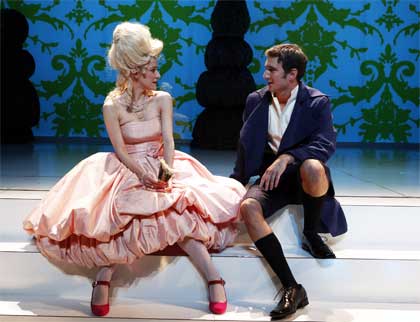
Photo by Joan Marcus
Courtesy of American Repertory Theatre
The director has made an attempt to vitalize this stillborn play with some elements of dramatic staging.
At one point, a whole bunch of dirt drops down from the ceiling, presumably to signify the moment of the Revolution.
That moment is pretty dramatic, but it does not really work enough magic to enliven this production. Most of the staging involves rows of characters sitting and facing the audience, trotting out some dialogue, then getting blasted off stage by some frightening sound. They are then replaced by another row of characters doing much the same kind of thing.
From time to time at the ART, over the years, there has been a tendency of productions to go somewhat overboard on staging technique at some expense to more subtle directorial innovations. In those cases, there have been dramatically staged moments of one sort or another, but the overall effect is not compelling.
Diane Paulus, now several years into her artistic directorship at the ART, has struck some interesting chords during her tenure with an experimental combination of different kinds of productions ranging from the essentially wordless, haunted house production of Sleep No More to the newly adapted, but fairly traditional, version of The Gershwins’ Porgy and Bess. Some of those experiments, in varying forms, have been quite compelling and interesting.
This one, however, came across as authorially unfocused and directorially flat, save for a few witty and dramatically staged moments. Tonally, its self-satirizing characterization felt off, and not as resounding a critique of upper class indulgence, as was obviously, and nobly, intended.
– BADMan
Leave a Reply