Play (2026)
World Premiere
by Matthew Lombardo
Directed by Noah Himmelstein
The Huntington Theatre
Symphony Hall area, Boston
April 3-18, 2026
Scenic Design: Alexander Dodge; Lighting Design: Elizabeth Harper, Costume Design: Alejo Vietti, Sound Design: John Gromada and Joel Abbott
With Beth Leavel (Brooke Remington), Matt Doyle (Jack Hawkins), Tomás Matos (Tobias Deschanel), Adam Heller (Freddie Carlton), Kevin Chamberlin (Oliver Kendall Walker), Marissa Jaret Winokur (Liz Jennings)
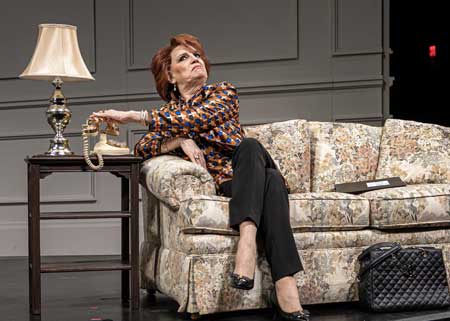
in “When Playwrights Kill”
Photo: Jim Sabitus
Jack Hawkins (Matt Doyle) is a youngish playwright who has written a one-woman show called The Return about an aging actress returning to the stage. His producer Freddie Carlton (Adam Heller) and director Oliver Kendall Walker (Kevin Chamberlin) come up with the idea of casting Brooke Remington (Beth Leavel), a diva whose time has come and gone. Hawkins is deeply suspicious, but they insist, and rehearsals begin. Rehearsals go even worse than Hawkins fears, with Remington missing obvious lines, adding script cues to her spoken lines, and failing every possible block on the stage. Hawkins is beside himself, but the show goes on. (See spoilers section below to find out what ultimately happens.)
Hawkins, Carlton, Walker, and a stage manager, Liz Jennings (Marissa Jaret Winokur), all pitch in to help ease the pain. As well, a very flamboyant prompter named Tobias Deschanel (Tomás Matos) shows up to help Remington get through her invariably forgotten lines by feeding them to her through hidden earphones.
At the beginning, in flashback, and the end of the show, Hawkins is shown in a straightjacket as he reflects on the trauma of being a playwright whose work is subjected to these challenges. He recalls the actual falling out between playwright Neil Simon and actor Mary Tyler Moore when she took the Broadway stage in 2003 for his show Rose’s Dilemma. Apparently, Simon had criticized Moore for not knowing her lines and Moore walked out. Such is the risk of signing a big TV star for the premiere of one’s play.
That is almost what the producers have done here with the cast of When Playwrights Kill in which almost all of the actors have starred in big Broadway shows. The audience adores seeing these familiar personalities onstage, and part of the amusement in attending this production is getting a kick out of the high that the audience gets in recognizing them.
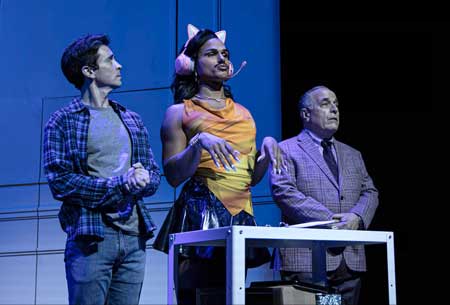
Tomás Matos as Tobias Deschanel
Adam Heller as Freddie Carlton
in “When Playwrights Kill”
Photo: Jim Sabitus
The actors are clearly adept and do good work at carrying off this mild spoof. Leavel is funny and flamboyant as the forgetful Remington, failing in her lines and moves in grand style. Heller is ferociously and effectively mercenary as the producer making the case for hiring a highly uncertain actress inevitable. Chamberlin is sweetly benevolent as the director. Doyle is appropriately contained, then effectively insane. And, as the stage manager, Winokur genially adds support to the madness. As Deschanel, Matos steals the show throughout as the highly flamboyant prompter, and who more literally steals the show at the end. (See spoilers below for clarifications.)
Though the Simon-Moore fiasco is invoked by Hawkins as a motivating gesture about actors and playwrights who come to blows, apparently the real model of such a fiasco for this show was playwright Lombardo’s attempt, seven years ago, to get Faye Dunaway onstage for a pre-Broadway tryout in Boston for a single-woman depiction of Katharine Hepburn in his play Tea at Five. By all accounts, it was a true fiasco, not only with Dunaway reportedly failing to learn her part, but with her acting in ways that the producers found offensive enough to fire her. The production never went to Broadway.
Here, Lombardo gives a funny and quite nuanced response to that inciting event by spoofing at producers and productions in general, casting a jaundiced eye at the finances behind theater production, and reveling in some of the wonderfully unexpected results of such ventures. (See spoilers below for more.)
The comedic writing here is amusing enough, but I found that the more straightforwardly poignant reflections, especially when Hawkins has the opportunity to reflect in soliloquy, more penetrating and satisfying. It is certainly fun to see the Broadway stars do their thing and to revel a bit in the meta-viewing of stars acting in a show about a star who cannot act. Matos is a lot of fun to watch, though the role is so flamboyant and over-the-top it makes me wonder if it might be a bit offensive to some. Though plenty of people in the audience applauded, guffawed and chortled with abandon, I found myself more quietly amused at some of the punch lines rather than swept away by the histrionics. Though the general setup proceeds fairly predictably for much of what transpires, the plot has a few interesting and unexpected twists, which does add intrigue. One cannot complain about the actors in this show – they are all professionals, and indeed know their lines and do a good job.
The set by Alexander Dodge, and lighting by Elizabeth Harper, are beautifully done, making a wonderful addition to this gently amusing comedy which sets its sights on something more uproarious but gains its edge in some of its quieter moments.
Leave a Reply