Musical (2026)
Book by Jen Silverman
Music, Lyrics, and Orchestrations by Dave Malloy
Music Supervision and Direction, Additional Arrangements by Or Matias
Directed and Choreographed by Sonya Tayeh
Based on the Searchlight Pictures Film Black Swan (2010), Story by Andres Heinz
American Repertory Theater
Loeb Drama Center, Harvard Square, Cambridge, MA
May 26 – July 12, 2026
Lighting Design: Isabella Byrd; Sound Design: Kai Harada; Costume Design: Shiona Turini; Illusion Design: Chris Fisher, Skylar Fox
With Melanie Moore (Nina), Jada Simone Clark (Lily), Amber Iman (LeRoy), Mehry Eslaminia (Barbara), Tory Trowbridge (Beth), Thom Sesma (Jacques/Rothbart), Kyle Brown (Ajay/Ensemble), Karli Dinardo (Glory/Ensemble), Gabriel Hyman (Ensemble), Charizma Lawrence (Ensemble), Adrian Lee (Ensemble), Caleb Marshall (Dylan/Ensemble), Ava Noble (Ensemble), Martell Ruffin (Ensemble), Ida Saki (Doppel), Anthony Santos (Ensemble), Sarah Sigman (Morgan/Ensemble) Chelsea Thedinga (Ensemble), Valeria Yamin (Ensemble)
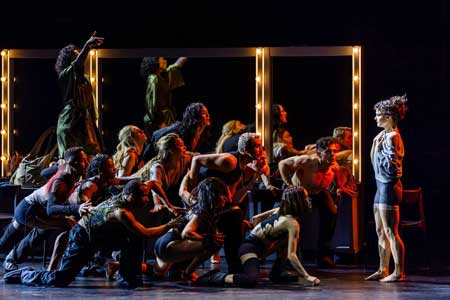
and Cast in
“Black Swan”
Photo: Hawver and Hall
Courtesy of American Repertory Theater
Nina Sayers (Melanie Moore) is a member of the troupe of a leading ballet company and they are slated to do Swan Lake. Beth (Tory Trowbridge), another member, has been promised the role by a director who has just become unable to direct, and Margaux LeRoy (Amber Iman) has been hired as the new director. LeRoy has indicated that she will carry out new auditions and select a new leading dancer. Beth is irate, but resigned, and Nina is possessed by the idea that she might be chosen. Nina’s mother, Barbara (Mehry Eslaminia) a former dancer, urges Nina on with an unrelenting nagging that is much more than motherly concern, and Nina takes the bait, now psychologically obsessed with getting the role. LeRoy does select Nina for it, which is a big win for Nina, but Lily (Jada Simone Clark), another talented dancer who seems psychologically more supple, is selected as Nina’s understudy and clearly is waiting in the wings for an opportunity to slip into the lead.
So begins the ordeal of preparing for the performance, which is a few weeks away. Nina’s good-girl-ness and buttoned-down perfectionism is beautifully suited to the role of the White Swan. But LeRoy challenges Nina to open some deep artistic and psychological doors to embody the other side of her leading role as the Black Swan. That is very tough for Nina to do, and there is a temptation for LeRoy to replace Nina with Lily, whose psychology, and artistic bent, is more flexibly suited to this sort of dynamic alteration in roles. But LeRoy sticks with Nina, who is desperate to star in this dual role, and whose mother continues to drive her towards doing it.
The night before dress rehearsals begin, Nina goes out to a club with other members of the troupe. She drinks too much alcohol and takes a drug which sends her off into an elaborate hallucination in which she envisions making passionate love with Lily and then stabbing her. The next day, Nina, hungover by the drug, arrives late. Jacques (Thom Sesma), the company director of the ballet, strongly urges LeRoy to replace Nina with Lily, but LeRoy stands her ground, and Nina is set to perform. And so she does, taking all of the power of her hallucinatory and psychologically unraveling experience to embody the role of the Black Swan. And though it is a searing, revealing and masterful performance, it comes at a price. (See spoilers below.)
This new musical adaptation of the psychological film thriller starring Natalie Portman which came out in 2010 certainly has its moments. The choreography by Sonya Tayeh, particularly in the first half, featuring a variety of settings with the entire ballet troupe, is absolutely exquisite, done with inventiveness and verve, and a commanding sense of excitement. There are a series of these scenes, and they are riveting. If one went to this production to see those alone, one would not be disappointed. There are also some excellent portrayals, notably Amber Iman as Margaux LeRoy, who offers all the piss and vinegar of an avant-garde dance director, and the ego and spine to stand up for it. She’s a pleasure to watch. And all of the dancers, in a variety of roles, do wonderful work both with their dramatic and with their dance roles; the dancing is exuberant and endless, and one can only imagine how exhausting it must be to perform this piece.
Dave Malloy is a composer and lyricist of curious range, demonstrating some vivid and wonderful capacity particularly in the more satirical numbers. The fast-paced number featuring the entire troupe at the gala ball (Gala Night) is really out of this world, another good reason to see this show. There are one or two other numbers like this, and they, in addition to the masterful choreography of the first half, represent the strengths of this show, and are certainly worthy of one’s attention.
Malloy’s writing elsewhere in the show, both in music and lyrics, is not particularly evocative. It attempts to be dramatic, but frequently has an unbridled energy that might be better shaped by the sorts of efforts he puts into those great satirical numbers in which his talents do come to the fore. The lyrics in those more unshaped numbers are occasionally expressive, but more usually are in a more routine vernacular that strives for expressiveness, but not quite getting there. And the music, in these arenas besides those appreciated above, tends to be too inchoate and explosive rather than nuanced and expressive. I had noticed this tendency in Malloy’s previous Natasha, Pierre and the Great Comet of 1812 (2012), which played at the American Repertory Theater in 2015. I loved the idea of doing a show based on Tolstoy’s War and Peace, but there was something about the execution, which exhibited a general lack of nuance in the service of something more bombastic (perhaps a dominant characteristic of an electropop musical), that kept surfacing.
The book of this adaptation of Black Swan does not depart very far from the film – not a fault in itself – but is on occasion cringe-worthy. The portrayal of Nina’s mother as so unsubtly committed to badgering her daughter makes it hard to take the character seriously. Similarly, with Jacques, the ballet company director, the portrayal is so blunt that one can barely have any sympathy for the business challenges he faces.
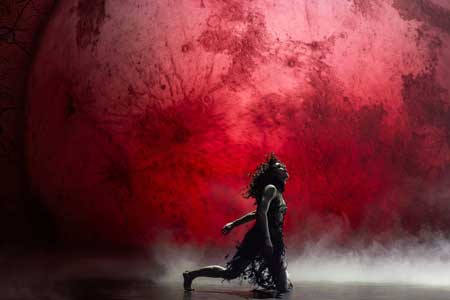
in “Black Swan”
Photo: Hawver and Hall
Courtesy of American Repertory Theater
The premier role of Nina is meant to carry to weight of the drama, and it does so with some significant capacity. The writing for the role of Nina in the original film is, to begin with, problematic, though actor Natalie Portman and director Darren Aronofsky do a reasonable job in carrying it off. In the current musical adaptation, the writing of the role has not improved upon the film, and the effect remains purely melodramatic rather than effectively dramatic. Melanie Moore, as Nina, does a reasonable job of evoking both the angelic and demonic sides of her character both as dancer and actor, but the overall effect, though shocking, is, because of the overall emphasis on melodrama, not dramatically gripping.
As is frequently the case, the American Repertory Theater exhibits lollapalooza stage effects to support all of this, with strobe lights in abundance, trompe l’oeil effects to convey Nina’s transformation into the Black Swan, a lot of stage smoke, and plenty more. Certainly, lighting designer Isabella Byrd, sound designer Kai Harada and illusion designers Chris Fisher and Skylar Fox have worked overtime and to significant effect. No doubt, this production is destined for Broadway, as are so many of these over-the-top ART productions, of which Dave Malloy’s Natasha, Pierre… was one. Though the production does have some truly great musical theater moments, notably with the choreography in the first half and a few beautifully composed and written numbers, it is more likely that its melodrama, its show-biz effects, and its often loud rock-style music, will bring in its audience.
The theme of artistic broadening and of the challenge of digging deep within oneself to convey art in its most expressive form – seemingly at the heart of the inspiration of this narrative – is clearly an important one. But the film, and the musical that has taken its inspiration from it, mostly skate on the surface of what that transformation entails, opting for broad rather than nuanced effect.
Overall: some great choreography, particularly in the first half, and a few great musical numbers, are the strengths, with a melodramatic story and a lot of stage theatrics seeking to make this high drama without really getting there.
– BADMan (aka Charles Munitz)
Leave a Reply