Film (2011)
Directed by Martin Scorsese
Screenplay by John Logan
Based on the novel The Invention of Hugo Cabret by Brian Selznick
Music by Howard Shore
Cinematography Robert Richardson
Editing by Thelma Schoonmaker
Starring Ben Kingsley, Sacha Baron Cohen, Asa Butterfield, Chloë Grace Moretz, Ray Winstone, Emily Mortimer, Jude Law
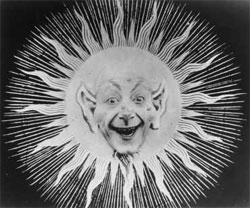
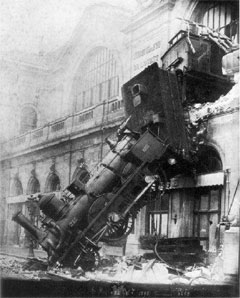
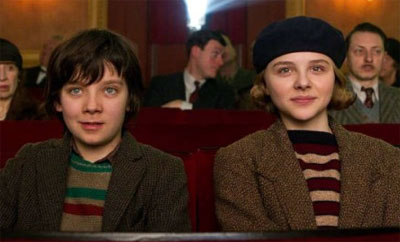
Hugo is an orphaned kid who lives in a railway station in Paris in the 1930s. He repairs clocks and gadgets, and envisions the creation of a humanoid automaton as a way of reconnecting with his deceased father (Jude Law) who sketched elaborate ideas for it. An omnipresent threat to Hugo’s continuing on in this way is the station security officer (Sasha Baron Cohen) who makes life miserable for Hugo and the other train station waifs. With his charming friend, Isabelle (Chloë Grace Moretz), Hugo explores the mysteries of the station and of the mechanisms which fascinate him; and eventually he brings her to the movies, to which her family (especially her godfather, played by Ben Kingsley) has inexplicably forbidden her to go. Kingsley’s character is also the disgruntled owner of a toy store in the train station; Hugo winds up making mischief there, but it evolves into more substantial contact. Indeed, there is a back story to that contact and leads, eventually, to the raison d’être of the film; let us just say that Hugo turns from being a railroad station romp to being a paean to early twentieth century French filmmaking.
Martin Scorsese, one of the great contemporary American directors, is best known for great and gritty epic studies like Mean Streets (1973), Taxi Driver (1976), Raging Bull (1980), The King of Comedy (1983) and Goodfellas (1990). All of those films have considerable edge and darkness; it is the unsentimental depiction of brutality mixed with a conscious irony that makes these films great.
More recently, Scorsese’s The Gangs of New York (2002), a dutiful historic epic, attempts grittiness but suffers from working too hard and inevitably falling short at being a period piece; it has little of the charm and radical verve of the earlier epics. It is an indicator of how a great filmmaker can go wrong.
Hugo has episodic charms, but it suffers from some of the same extrapolations that make The Gangs of New York a weak film. In short, Scorsese seems out of his element. Much as it would seem he would like to be a jack of all film trades, it may be that he is more of a specialist than a generalist.
Hugo targets a wide audience (it was released during the holiday season) with an array of interests that seem like odd bedfellows. It is an amalgamation of a kids from 8 to 80 holiday film, a 3D visual effects foray, a paean to the cinema by one of the great directors, and a Francophile travelthon. It makes no attempt at grittiness; the only vague insinuations of that are in the annoyed and grumpy demeanors of the Sacha Baron Cohen and Ben Kingsley characters. Its basic mode is sentimental, meant to convey a kind of sepia daguerrotype charm; it is about as far from Raging Bull or Taxi Driver as one can be.
The film attempts to create drama with attenuated pacing, but, despite its intended purpose, it winds up being ponderous. The captured glances and the waiting of the camera on significant moments is enough to make one scream at certain points. The film takes forever to get where it is going and it is only in the last half hour or so that one gets a feeling for where its motivation lies.
Did Scorsese want to make a variant of Amélie (the 2001 French film fable directed by Jean-Pierre Jeunet), another story of a romantic, visionary and charming waif?
But Amélie is as wildly improvisational and inventive as Hugo is deliberate and forcefully metaphoric. In Hugo, the overdosing of the metaphor (of mechanical repair re the healing of wounded selves) is done weightily, not playfully and whimsically as is done in Amélie.
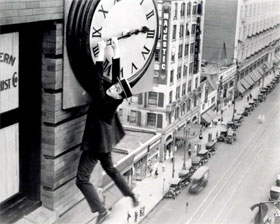
This would have been a much better film if, from the outset it declared its central interest and exhibited the kind of passion for cinema shown straightforwardly and effectively by Cinema Paradiso, the 1988 film by Giuseppe Tornatore. If it just got to its point and left off the heavy metaphor, the 3D effects and its intensely deliberate narrative, it could have conveyed its honest inspiration more directly.
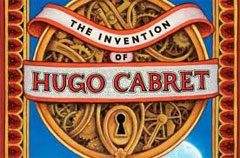
Part of the problem is that it is taking its cue from Selznick’s imaginative story which seems to have considerable charm as a graphic novel but which does not translate as well into Scorsese’s style of filmmaking. The book’s way of interleaving text and image appears to provide a kind of spaciousness and poetic grace that supports its gradually unwinding historic mystery. Scorsese seems best with intense narrative and energetic pacing, very different from what this novel offers.
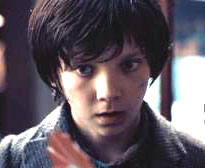
Asa Butterfield, as Hugo, evokes the appropriate mixture of innocence and stealth. Seeming a bit like a deer in the headlights crossed with an astute fox, he’s like a younger version of Bud Cort, when he played the hypnotically curious heroes of Hal Ashby’s Harold and Maude (1971) and of Robert Altman’s Brewster McCloud (1970).
Ben Kingsley is dutifully grumpy and endearing in the lurking mystery role.
Sacha Baron Cohen (best known for his caricature portrayal of the Kazakhstani character Borat from his daring and raunchy 2006 film of the same name) is silly in the right way as the station gendarme. It is interesting to see him behaving himself as an actor in someone else’s film.
Emily Mortimer, who was featured in Lars and The Real Girl (2007), has a gentle and pleasing charm which serves her well as the gendarme’s love interest.
Chloë Grace Moretz as Isabelle is a stunningly captivating compatriot to Hugo and is the film’s primary source of energy and sparkle before it finally turns to its other passion, early French film. She radiates early signs of film stardom.


– BADMan
Leave a Reply