Play (2023)
by David Auburn
Directed by Paula Plum
Central Square Theater
Central Square, Cambridge, MA
November 6-30, 2025
Scenic Designer: Kristin Loeffler; Lighting Designer: Deb Sullivan; Projection Designer: Justin LaHue
With Lee Mikeska Gardner (Diana), Laura Latreille (Alice)
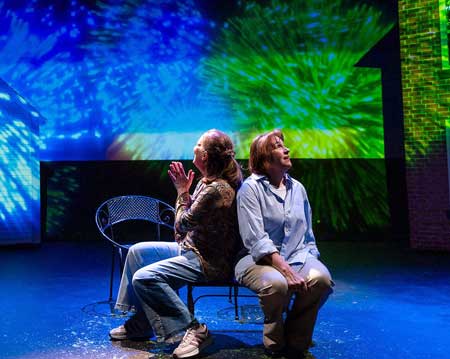
Lee Mikeska Gardner as Diana
in “Summer, 1976”
Photo: Nile Scott Studios
Courtesy of Central Square Theater
It is 1976 in Columbus, Ohio and Alice (Laura Latreille), a somewhat hippie-ish mother of a young daughter, is married to a professor at the local university. Her house is being painted, slowly, by a student of the professor, which seems odd and inefficient to Diana (Lee Mikeska Gardner), Alice’s next door neighbor. Diana is the mother of a young daughter of roughly the same age, but, other than that, Alice and Diana do not seem to have much in common. At one point, however, Alice offers Diana, who Alice thinks is particularly straight-laced, a joint, at which point Diana, clearly challenged to show her hipness, takes several incredibly long drags. This leads to an opening and an unexpected bonding between the two women. As things develop, what seems like a very ordinary situation shows significant changes (see spoilers section for details), which causes some potential contingent developments in the relationship of the women. But there is drama in the writing as well as in the situation, and the unexpected and unlikely denouement trades thematic places with the routine and the much expected as the cleverly developed narrative unfolds.
David Auburn’s great play Proof (2000) is a masterwork of the unexpected, and Summer, 1976 shares in some of that unexpectedness. The curious feature of this play is that, on the one hand, it is absolutely ordinary in its discursive development which leans heavily on long, though wonderfully written and delivered, speeches by the two characters. On the other hand, the ordinariness, which settles in after a while, gets challenged at various intervals, much in the same way that, in Proof, the seemingly ordinary and expected series of events gets strikingly overturned at the end of the first act. (I won’t say more – go see it, or see the excellent film (2005) written by David Auburn and directed by John Madden, with Gwyneth Paltrow and Anthony Hopkins.)
One of the things that ties the two women is a babysitting coop that has been managed by Doug, Alice’s husband, who is an economist and who has figured out all of the necessary details for “paying” and “getting paid” within the system. But Alice starts messing with things, adding extra babysitting credits to some of the accounts, which, hilariously, leads to babysitting coop inflation. This is an entertaining device, but also gives a sense of Doug’s seemingly dutiful obsession with perfection and with Alice’s roguishness, an amusing vignette of who Alice and Doug are, and which gives a hint of the ordinary patterns, and the hidden cracks, of their relationship.
One might, theoretically, in the opening scenes, get bored by what seems an endless trading of soliloquies by Diana and Alice, but the writing is very good and the deliveries by these two excellent actors make it all wonderfully digestible. Gardner, as Diana, offers a slightly starchy account, appropriately so, but not so much that her character refuses to bend. And Latreille, as Alice, seems a bit alternative and hippie-ish, but also domestic – traits which Diana, in one of her pointed speeches – identifies wryly. Though each character has a way of critically pigeonholing the other early on, we never lose sympathy with either character as a result of that, and it is the deftness of writing, and the sympathetic delivery by these actors, that makes them appealingly vulnerable. Kudos to director Paula Plum for enabling this deft pairing, done subtly and beautifully, in what comes across as a very down-to-earth and realistic, yet astute and pointed, depiction of of an adult relationship between women, with portrayals that are vivid without being histrionic.
The staging is simple, but embellished with a video display, by Justin LaHue, on the backdrop, that changes subtly, giving a sense of the alteration of time and the changing of seasons. Though much of the play takes place in – as told – the summer of 1976, there are some time modifications, as things develop, and the moving background gives a dynamic sense that what appears to be just the now is the skin of a universe in flux.
Saying too much about what happens shakes the subtle drama out of the play, burt, if you don’t care too much about that before you see it, read the spoilers.
– BADMan (aka Charles Munitz)
Leave a Reply