• Skip to main content
  • Skip to primary sidebar

Boston Arts Diary

Aesthetic encounters in the Boston area and sometimes beyond

Disgraced

January 13, 2016 by admin Leave a Comment

Play (2012)
by Ayad Akhtar

Directed by Gordon Edelstein

Huntington Theatre Company
Boston University Theater
Symphony Hall area
Boston

January 8 – February 7, 2016

With Rajesh Bose (Amir), Nicole Lowrance (Emily), Mohit Gautam (Abe), Benim Foster (Isaac), Shirine Babb (Jory)
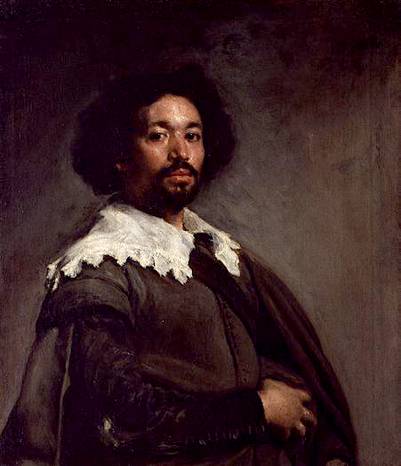
Diego Velázquez, 'Portrait of Juan de Pareja'
Diego Velázquez
“Portrait of Juan de Pareja”
Metropolitan Museum of Art
A comedic melodrama featuring a Pakistani Muslim corporate attorney in New York, his Caucasian American artist wife, a female African-American lawyer colleague, and her white Jewish-American art-dealer husband. Sparks fly.

It turns out that Amir Kapoor (Rajesh Bose), who has the appearance of someone from someplace in South Asia, has changed his last name from Abdullah to Kapoor, and somewhat misrepresented his birthplace, not quite owning up to the fact that he’s not exactly what he portrays himself to be. It seems it’s been better for his career in a dominantly Jewish New York corporate law firm to generate expectations he’s Indian and Hindu, rather than what he is, Pakistani and Muslim.

He’s recently been hoping for a partnership in the firm for which he has worked tremendously hard. His wife, Emily (Nicole Lowrance), meanwhile, is an artist who is fascinated by Muslim themes and has, among other things, painted a portrait of Amir inspired by Velasquez’ Portrait of Juan de Pareja (c. 1650) which depicts a slave of Moorish descent who was an assistant in the artist’s workshop. She hopes to get the work exhibited in a gallery owned by Isaac (Benim Foster). He, curiously, is the Jewish husband of the African-American woman law colleague of Amir’s, Jory (Shirine Babb).

Meanwhile, Amir’s nephew, Abe (Mohit Gautam), originally named Hussein, asks Amir to help defend the cleric at his mosque who has been brought up on terrorism charges.

There is more than meets the eye in some of these relationships and once things begin to emerge, sparks fly.
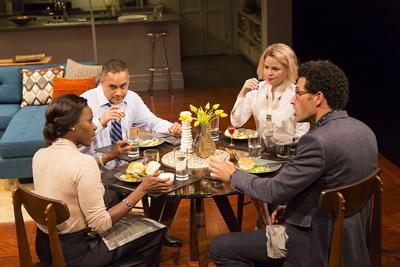
Shirine Babb as Jory, Rajesh Bose as Amir, Nicole Lowrance as Emily, Benim Foster as Isaac in 'Disgraced'
Shirine Babb as Jory
Rajesh Bose as Amir
Nicole Lowrance as Emily
Benim Foster as Isaac
in “Disgraced”
Photo: T. Charles Erickson
Courtesy of Huntington Theatre Company

This curious play, obviously touching from a variety of angles on a lot of sensitive issues, takes as its focus the anguished status of its Muslim protagonist, Amir. He rails against the Koran, identifying it as the source of a lot of prejudicial behavior, including the mistreatment of women. Against Muslim tradition, Amir, who very much identifies as a modern urban type in New York, drinks and eats pork. Clearly he’s not a devout Muslim, but when confronted with questions from his wife and friends about his feelings about the attacks of 9/11, his answer draws surprise. While trying to be enlightened, he also expresses a strong sense of identity with his cultural roots and when that becomes evident it generates a considerable response from the others in his midst. Ultimately, it is his unresolved anguish as a Muslim that he must confront and which becomes the cause of ensuing interactions with his Caucasian wife, his African-American female colleague, and her Jewish husband.
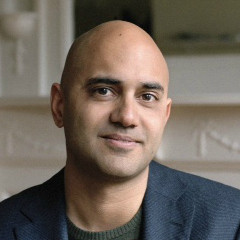
Playwright Ayad Akhtar
Photo: Courtesy of Huntington Theatre Company

Playwright Ayad Akhtar has certainly set things up to produce a lot of conflict. By putting together in close relationship and at such close range the varied array of cultural types he does here provides the raw materials for conflagration. Explosive interactions logically follow from this collection of types when agitated just enough. When relevant ideological chatter leads to personal interactions that begin to boil, emotions overflow in a variety of ways that emerge from each cultural angle.

Mohit Gautam as Abe, Nicole Lowrance as Emily, Rajesh Bose as Amir in 'Disgraced'
Mohit Gautam as Abe
Nicole Lowrance as Emily
Rajesh Bose as Amir
in “Disgraced”
Photo: T. Charles Erickson
Courtesy of Huntington Theatre Company

The outcome is at points interesting but also so manufactured out of its intentionally combustible elements that one feels a certain mechanical quality in its narrative. As result, the consequences of the manufactured conflicts don’t feel like a discovery based on the unfolding of character but a series of explosions that characterizes the chemistry of typed human elements. The play’s eventual pyrotechnics keep one alert, but they too, like much of the play’s narrative presumptions, feel like carefully wrought displays of flashing light rather than evocative and exploratory movements of people in trying circumstances.

The current production offers some good performances, and the play, despite its narrative weaknesses, makes an interesting case for how the sense of shame incurred by a complex of cultural impositions helps to germinate the seeds of Muslim rage.

Curiously, the play won the Pulitzer Prize in 2013.

Post viewing analysis - contains spoilers
That Isaac is having an affair with Emily seems like a weird plot device. It’s not necessary to the play and it just complicates and confuses the narrative. It, along with the suggested portrayal of Amir’s Jewish law partners, seems like a collective portrayal of Jews that is unnecessarily unflattering, gratuitous, and, again, not germane to the narrative.

When asked how he feels about the attacks of 9/11 and whether he has a touch of pride associated with that, Amir answers in the affirmative, which shocks all of the assembled. But the moment does not get played out adequately. If the play actually spent time bearing that out and explaining it, it would be far better, but it leaves it hanging while spending much too much time on its melodramatic developments.

In the last scene, after Amir and Emily have broken up and are back in their apartment packing up, Amir makes a plea that Emily, despite his having beaten her brutally in a fit of jealous rage about her infidelity with Isaac, should come away from their marriage feeling some kind of pride in their being together. It’s a pathetic line and not well framed by the play.

Emily’s portrait of Amir is taken out at the end and displayed in a final tableau, as though this is a realization of that pride, but the statement, though interesting, makes a point without having explored the underlying psychological complexities adequately. The play presumes to gives a sense of that feeling of disgrace which motivates the feelings and actions of someone like Amir, but does not go enough of the distance to give a sense of what that is really about.

– BADMan

Filed Under: Plays

Reader Interactions

Leave a Reply

Your email address will not be published. Required fields are marked *

Primary Sidebar

Pages

  • Up, and Coming…
    • Boston Area
      • Museums and Galleries
      • Music
      • Theatre
  • Contact Us
  • So Noted…
  • Subscribe to Email Newsletter
  • Supporting Boston Arts Diary
    • Shop at Amazon

Categories

  • Animated
  • Benefits
  • Circus
  • Concerts
  • Costume and Clothing Design
  • Dance
  • Documentaries
  • Festivals
  • Guest Commentary
  • In Memoriam
  • Installations
  • Interviews
  • Lectures and Panel Discussions
  • Movies
  • Museums and Galleries
  • Musicals
  • Operas
  • Operettas
  • Paintings
  • Performance Art
  • Plays
  • Poetry
  • Prints
  • Public Art
  • Puppetry
  • Readings
  • Recordings
  • Reflections
  • Sculpture
  • Storytelling
  • TV
  • Uncategorized
  • Wooden Boats

Archives

Recent Posts

  • When Playwrights Kill
  • Breaking the Code
  • Charlotte’s Web
  • Mistral Goes to Hollywood
  • The Moderate

Twitter

Follow @BostonArtsDiary

Pages

  • Up, and Coming…
    • Boston Area
      • Museums and Galleries
      • Music
      • Theatre
  • Contact Us
  • So Noted…
  • Subscribe to Email Newsletter
  • Supporting Boston Arts Diary
    • Shop at Amazon

Categories

  • Animated
  • Benefits
  • Circus
  • Concerts
  • Costume and Clothing Design
  • Dance
  • Documentaries
  • Festivals
  • Guest Commentary
  • In Memoriam
  • Installations
  • Interviews
  • Lectures and Panel Discussions
  • Movies
  • Museums and Galleries
  • Musicals
  • Operas
  • Operettas
  • Paintings
  • Performance Art
  • Plays
  • Poetry
  • Prints
  • Public Art
  • Puppetry
  • Readings
  • Recordings
  • Reflections
  • Sculpture
  • Storytelling
  • TV
  • Uncategorized
  • Wooden Boats

Archives

Recent Posts

  • When Playwrights Kill
  • Breaking the Code
  • Charlotte’s Web
  • Mistral Goes to Hollywood
  • The Moderate

Twitter

Follow @BostonArtsDiary

Copyright © 2026 · Magazine Pro on Genesis Framework · WordPress · Log in