Film (2014)
in Arabic with English subtitles
Directed by Naji Abu Nowar
Screenplay by Naji Abu Nowar, Bassel Ghandour
Music by Jerry Lane; Cinematography by Wolfgang Thaler, Film Editing by Rupert Lloyd
Kendall Square Cinema, Cambridge, MA
With Jacir Eid Al-Hwietat (Theeb), Hussein Salameh Al-Sweilhiyeen (Hussein), Hassan Mutlag Al-Maraiyeh (The Stranger), Jack Fox (Edward)
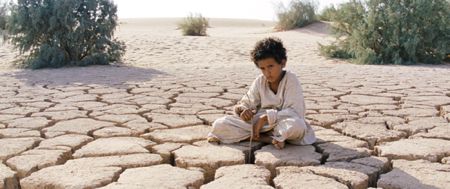
in “Theeb”
Photo: Film Movement
Set in 1916 in Arabia and told through the eyes of a young boy, Theeb (Jacir Eid Al-Hwietat), this film delivers an inside portrait of tribal life during World War I when complicated relationships between the Ottomans, the British, and local tribal Bedouins prevailed. Issues about technology and modernization – the new train line is nicknamed the Iron Monkey by the Bedouins – and the evident emerging problems territoriality that emerge during that fraught time are implicit in this small drama.
Theeb is not meant to go along on the journey through the desert which his older brother, Hussein (Hussein Salameh Al-Sweilhiyeen), undertakes to guide a British soldier, Edward (Jack Fox) towards a railway, but, determined to follow along he becomes a member of the party. What ensues is a complex and sometimes horrific unfolding of the conflicts between the powers in the region, and Theeb, along with the others, is caught in the crossfire.
Putting a young boy at the center of the conflict accentuates the severity of the effects of bitter conflict and one is left with a sense of the desperate imprints the series of complications has on his vulnerable psyche.
The pace of the film is generally attenuated, with long, quiet sequences accentuated by extended panning shots. The vast quiet of the general narrative is punctuated periodically by dramatic sounds and movements. The film is not at all without action – it is quite dramatic throughout – but the frame of those moments is languorous.
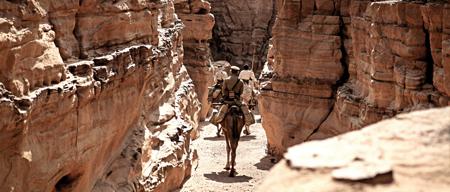
Photo:Film Movement
There is some truly beautiful photography here – extensive and dramatic desert shots that give a sense of the beautiful and naturally sacred vista that gradually gets corrupted by technologically inspired war and by the associated invasion of the railroad. Paying close attention to details of the environment, the film sometimes dwells on closeups of beetles and flies. There are beautiful shots of the camels and riders making their way through a close rocky canyon, the sedimentation of the rising walls vivid, intense and suggestive of the many layers of history and culture that fill the context. Lingering scenes take place in the dark, yielding a realistic sense but providing some challenge to the viewer.
Though the sense of Theeb’s innocence and vulnerability are at the core of the drama, it’s not always clear what the impetus for creating a narrative from a child’s perspective might be. Nor is it always entirely clear what actual historical conflicts are being portrayed.
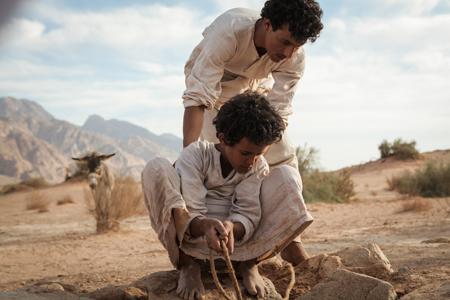
Hussein Salameh Al-Sweilhiyeen as Hussein
in “Theeb”
Photo: Film Movement
The second part of the film, involving an odd and elongated partnership between Theeb and a stranger (Hassan Mutlag Al-Maraiyeh), is unexpectedly touching. Suggesting the contradictions of tribal rivalry and the periodic necessity of tribal collaboration, it evokes a sense of the complicated relationships that emerge within the inevitable but problematic onset of modern civilization.
This film is evocative, but somewhat too inclined not to explicate its narrative. Nonetheless, through its quiet and deliberate pacing, its punctuation of dramatic conflict, and the vulnerability and wiliness of its youthful protagonist, it gives a sense of the deep cultural tragedies that underlie the Middle East of today.
– BADMan
Leave a Reply