• Skip to main content
  • Skip to primary sidebar

Boston Arts Diary

Aesthetic encounters in the Boston area and sometimes beyond

We Are What We Are

October 11, 2013 by admin Leave a Comment

Film (2013)

Inspired by Somos Lo Que Hay (Mexican, 2010), directed by Jorge Michel Grau

Directed by Jim Mickle
Screenplay by Nick Damici, Jim Mickle

With Kelly McGillis (Marge), Odeya Rush (Alyce Parker), Ambyr Childers (Iris Parker), Wyatt Russell (Deputy Anders), Julia Garner (Rose Parker), Michael Parks (Doc Barrow), Bill Sage (Frank Parker), Nick Damici (Sheriff Meeks), Jack Gore (Rory Parker)
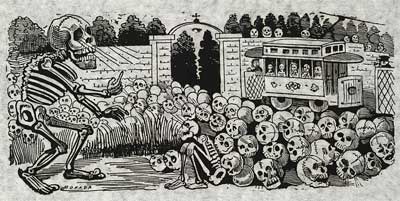
José Guadalupe Posada (Mexico, 1852 - 1913},'Gran calavera eléctrica (Grand electric skull)'
José Guadalupe Posada (Mexico, 1852 – 1913)
“Gran calavera eléctrica (Grand electric skull)”
A horror-suspense film in a somewhat different mode – darkly restrained, then plenty grisly – about a family with odd and extreme practices carried out and handed on with religious fervor.

Based on a Mexican film of the same stripe, this film follows the doings of the Parker family, mostly inside the confines of their mysterious dwelling.

The paterfamilias, Jack (Bill Sage) has odd religious ideas. Early on we learn of his notions about abstinence from certain kinds of foods; no cereal for some period of time is ritually ordained, and little Rory (Jack Gore!) falls afoul of his Dad for downing some mistimed Cheerios. But that is the least of it; more dangerous culinary practices prevail. Amazingly, two beautiful, well-spoken, charming blond, daughters, Iris (Ambyr Childers) and Rose (Julia Garner), manage to keep their personalities intact through most of it, but even they wind up getting caught up in intense and personally challenging dining options.
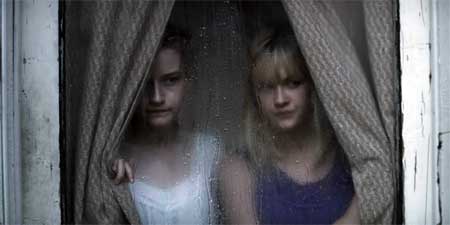
Julia Garner as Rose, Ambyr Childers as Iris in 'We Are What We Are'
Julia Garner as Rose
Ambyr Childers as Iris
in “We Are What We Are”
© 2013 Entertainment One Films US

“We Are What We Are” is a truism, but it also is a statement of self-acceptance at whatever cost, and this family has paid the high price to abide by their practices and to stand by them as though they were truthful.

Regardless of the literal human price, such blind belief offers a potent narcotic influential in obedient child rearing. With just the right mixture of lunacy and terror, “Daddy” works miracles in controlling his children.

One can imagine a Mexican thriller on this theme dwelling on macabre Day of the Dead imagery. But in this American reworking, the setting is, surprisingly, somewhere in the Catskills of New York State. Even so, this is so dark that the terrifying Winter’s Bone (2010), by comparison, set in the creepiest backwoods shanties of Arkansas, seems like Goldilocks and the Three Bears.
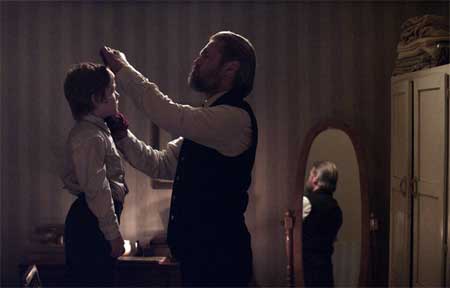
Jack Gore as Rory, Bill Sage as Frank in 'We Are What We Are'
Jack Gore as Rory
Bill Sage as Frank
in ‘We Are What We Are’
© 2013 Entertainment One Films US

The revelations grow and build to a final scene, a true rival for Babette’s Feast in the horror realm. But, after that, the most chilling scene of the film appears, with characters simply driving in a car with a book on the seat. The real fright occurs after the flood.

There is nothing supernatural here, but neither is there much psychological probing. In Hitchock’s films, we usually get some perspective on the warped personalities involved and are frequently surprised by them in one way or another. Here, there are fewer surprises, save at the very end.

The film is reasonably well put together though there is a little dorkiness in the script here and there. When, for example, Iris and Anders (Wyatt Russell) are exchanging flirtations, he says I’ll see you around and she replies not if I see you first, it seems like an effort to underscore the seeming ordinariness obscuring the total weirdness, but it winds up just sounding trite.

A recent interview with Jim Mickle in Boston Arts Diary.

There is also a medical component here, enough to give one serious diagnostic pause about the next bowl of soup one might ingest.

If one regards Hitchcock’s work as artful horror, one must call this sort of film art house horror, indie-bound in its considerable restraint, but perhaps appealing to a broader audience with its more vividly horrific moments, with somewhat less psychological exploration and less evolved cinematic technique than Hitchcock.

Post viewing analysis - contains spoilers
What I want to know is how this nutty father got two such sweet and charming daughters? They do wear the latest in evangelical domestic ware, indicating the general craziness of their home environment, but, other than that, they seem like regular kids. How they manage to carry on in school (where Iris meets Anders) is perhaps the biggest mystery. And why, in the end, do they develop such raw and earnest taste for their father? It fits with the cannibalism theme, but there is something werewolfish about that “ingest” scene that does not fit with the more normal depraved lunatic part of the film.

All of this is pretty eerie considering the news recently about Ariel Castro, who captured and held several women in his basement in Cleveland for many years. The chilling part of that story, and this story, is how veiled craziness can be and how easy it is for a megalomaniac to bring others into his influence.

– BADMan

Filed Under: Movies

Reader Interactions

Leave a Reply

Your email address will not be published. Required fields are marked *

Primary Sidebar

Pages

  • Up, and Coming…
    • Boston Area
      • Museums and Galleries
      • Music
      • Theatre
  • Contact Us
  • So Noted…
  • Subscribe to Email Newsletter
  • Supporting Boston Arts Diary
    • Shop at Amazon

Categories

  • Animated
  • Benefits
  • Circus
  • Concerts
  • Costume and Clothing Design
  • Dance
  • Documentaries
  • Festivals
  • Guest Commentary
  • In Memoriam
  • Installations
  • Interviews
  • Lectures and Panel Discussions
  • Movies
  • Museums and Galleries
  • Musicals
  • Operas
  • Operettas
  • Paintings
  • Performance Art
  • Plays
  • Poetry
  • Prints
  • Public Art
  • Puppetry
  • Readings
  • Recordings
  • Reflections
  • Sculpture
  • Storytelling
  • TV
  • Uncategorized
  • Wooden Boats

Archives

Recent Posts

  • When Playwrights Kill
  • Breaking the Code
  • Charlotte’s Web
  • Mistral Goes to Hollywood
  • The Moderate

Twitter

Follow @BostonArtsDiary

Pages

  • Up, and Coming…
    • Boston Area
      • Museums and Galleries
      • Music
      • Theatre
  • Contact Us
  • So Noted…
  • Subscribe to Email Newsletter
  • Supporting Boston Arts Diary
    • Shop at Amazon

Categories

  • Animated
  • Benefits
  • Circus
  • Concerts
  • Costume and Clothing Design
  • Dance
  • Documentaries
  • Festivals
  • Guest Commentary
  • In Memoriam
  • Installations
  • Interviews
  • Lectures and Panel Discussions
  • Movies
  • Museums and Galleries
  • Musicals
  • Operas
  • Operettas
  • Paintings
  • Performance Art
  • Plays
  • Poetry
  • Prints
  • Public Art
  • Puppetry
  • Readings
  • Recordings
  • Reflections
  • Sculpture
  • Storytelling
  • TV
  • Uncategorized
  • Wooden Boats

Archives

Recent Posts

  • When Playwrights Kill
  • Breaking the Code
  • Charlotte’s Web
  • Mistral Goes to Hollywood
  • The Moderate

Twitter

Follow @BostonArtsDiary

Copyright © 2026 · Magazine Pro on Genesis Framework · WordPress · Log in