Play (2010)
by Bruce Norris
Directed by M. Bevin O’Gara
Speakeasy Stage Company
Stanford Calderwood Pavilion
Boston Center for the Arts
Boston, MA
March 1 – April 6, 2013
Scenic Design: Cristina Todesco, Costume Design: Mary Lauve, Lighting Design: Deb Sullivan, Sound Design: Arshan Gailus
With Thomas Derrah (Russ, Dan), Michael Kaye (Karl, Steve), Marvelyn McFarlane (Francine, Lena), Philana Mia (Betsy, Lindsey), DeLance Minefee (Albert, Kevin), Paula Plum (Bev, Kathy), Tim Spears (Jim, Tom)
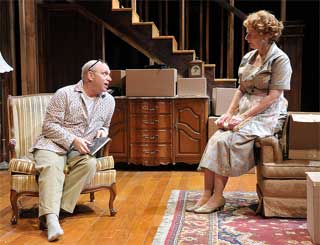
Paula Plum as Bev
in “Clybourne Park”
Photo: Craig Bailey/Perspective Photo
Courtesy Speakeasy Stage Company
In the first act, we find Russ (Thomas Derrah) and Bev (Paula Plum) at home in Chicago, in a state of transition. They are planning to move and things are all over place. Some banter about geography and word usage introduces a lightness that gently frames what follows.
Their maid, Francine (Marvelyn McFarlane), attends to them in their last days of residency, and her husband, Albert (DeLance Minefee) enters later, offering, generously but unbidden, to help. Jim (Tim Spears) a minister, provides some feeble attempts at amiable companionship and religious guidance.
Karl (Michael Kaye), a severe neighbor, enters with his deaf wife Betsy (Philana Mia) to discuss the pending real estate transaction. As things develop, we learn more of Bev’s and Russ’ family history, and of their decision to sell and to whom.
In the second act, set fifty years later in 2009, the neighborhood has changed. The scene is set in the same house, but now a young couple, Tom (Tim Spears) and Lindsey (Philana Mia), are hoping to renovate. There is some concern expressed about the extent of the renovations by the neighborhood association, represented by Kevin (De Lance Minefee) and Lena (Marvelyn McFarlane). Kathy (Paula Plum) lends lawyerly assistance, while Dan (Thomas Derrah), a contractor, probes treasures in the back yard in the course of removing a dead tree.
This beautifully written play has a simplicity and straightforwardness about it that makes it entirely believable. At the same time, it creates palpable tensions and climaxes that seem to come out of nowhere. Both acts begin with long stretches of dialogue in which nothing significant happens. Just as one begins to wonder whether it will all be banter, the knots begin to form, and before one knows it, a deep dramatic pit opens beneath.
The setting of the play is in a house that figures in Lorraine Hansberry’s A Raisin In The Sun (currently in a run at the Huntington Theatre Company), and the history of that play provides a narrative base for this one. Obviously, racial issues become involved, but so do issues of class, war, violence and loss. It is amazing how artfully Norris weaves all of these themes together, and how seamlessly and naturally they all appear.
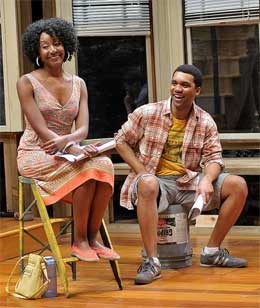
DeLance Minefee as Kevin
in “Clybourne Park”
Photo: Craig Bailey/Perspective Photo
Courtesy Speakeasy Stage Company
The acting and direction in this production are first rate. The switching of roles from the first to second act gives all the actors a chance to show their considerable versatility.
Thomas Derrah, as Russ, in the first act, is a devastatingly effective presence, roaring out of a quiet harbor into a ferocious sea. In a lesser role of Dan, in the second act, he is as airy as he is weighty in the first act. A founding, and very long-time, member of the American Repertory Theatre, Derrah has branched out in the past several years, appearing dramatically and forcefully at the Speakeasy Stage last season in Red, and very comedically, this season, at the Actors’ Shakespeare Project in Two Gentlemen of Verona. It is nice to see his abundantly versatile talents spread around.
Paula Plum, as Bev, in the first act, is a touchingly awkward and hesitating presence, trying to bend around Russ’ intensities and to accommodate Albert’s (DeLance Minefee) generosity. Plum conveys a vulnerable sweetness in this role that is just the opposite of her portrayal of Kathy, a toughened lawyer, in the second act; the adeptness of the switch is striking. Plum is a long time member of the company at the Actors’ Shakespeare Project where she has displayed her considerable range in numerous outings, most recently, earlier this season, as the most capable director of Macbeth. She also appeared very effectively earlier this season in the beautifully executed 33 Variations at the Lyric Stage Company.
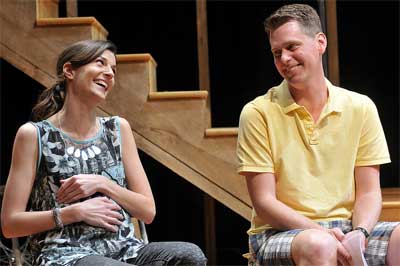
Michael Kaye as Steve
in “Clybourne Park”
Photo: Craig Bailey/Perspective Photo
Courtesy Speakeasy Stage Company
Even more striking is the transformation that Philana Mia pulls off between the two acts. In the first, she is Betsy, the deaf wife of Karl, uttering semi-comprehensible phrases with seeming authenticity. In the second act she plays Lindsey, a fast talking, suave and sleek, prospective mother who is desperate to renovate her new home.
Marvelyn McFarlane is a demure, though resentful, maid in act one. In act two, she becomes a wild and alluring presence, outspoken and forceful.
Tim Spears, DeLance Minefee, and Michael Kaye also provide vivid characterizations.
The ensemble work in this play is expertly done. There is generally such good acting all around that one must especially commend the director, M. Bevin O’Gara, for inspiring and helping to enable such consistently good results.
The set is dynamic and visually interesting without being intrusive. Representing the same house fifty years later, in the second act, involves a quite energetic change of scenery during intermission which engages a very active and busy team of stagehands, providing an inadvertent, but entertaining, entr’acte.
The Speakeasy Stage has pulled out a real winner with this production.
– BADMan
Leave a Reply