Play (2011)
by Jon Robin Baitz
Directed by Scott Edmiston
Speakeasy Stage Company
Boston Center for the Arts
Boston, MA
January 11 – February 9, 2013
Scenic Design: Janie E. Howland, Lighting Design: Karen Perlow, Original Music/SoundDesign: Dewey Dellay
With Anne Gottlieb (Brooke Wyeth), Karen MacDonald (Polly Wyeth), Munson Hicks (Lyman Wyeth), Christopher Smith (Trip Wyeth), Nancy E. Carroll (Silda Grauman)

by Mary Vaux Walcott
Brooke Wyeth (Anne Gottlieb) has returned to her parents’ home in Southern California at Christmas time. In addition to her parents, Polly (Karen MacDonald) and Lyman (Munson Hicks), she encounters her brother, Trip (Christopher Smith) and her aunt, Silda (Nancy E. Carroll). When Brooke reveals that she has written and will be publishing a personal memoir about the family and its signal challenging event, Brooke’s parents become incensed. Arguments ensue between Brooke and her parents; her brother, Trip (Christopher Smith) and her aunt, Silda (Nancy E. Carroll) weigh in during the intervals. Arguments evolve until, eventually, they can no longer be endured.

Anne Gottlieb (Brooke)
Nancy E. Carroll (Silda)
in “Other Desert Cities”
Photo: Saglio Photography, Inc.
Courtesy Speakeasy Stage Company
This is a play about family values, and explores that theme in numerous curious dimensions. The unfolding of those multiple dimensions, as the play winds down to its end, makes for its dramatic impact.
Jon Robin Baitz wrote this play in the difficult aftermath of his dismissal from the team of Brothers and Sisters (2006-2011), a TV serial he created. Apparently, he had wanted to include grittier and more difficult material in the show and met with differences of opinion that resulted in his termination.
Other Desert Cities, about siblings, their relations to one another and to parents, brings up a challenging history and the attempt of a child to confront it. The result is a work that rises from a humdrum foundation to a dramatic perch.
The characterization of Polly, in particular, as a very assimilated Jew, provides a bit of additional curiosity to a tale about conservative Southern Californians. Lyman, a non-Jew (with Munson Hicks entirely believable in the role), is a retired actor. In addition to invoking Ronald and Nancy Reagan in their dialogue, the Wyeth parents embody a similar ethos to them.
Silda is an offbeat foil, less assimilated and more politically progressive than her sister and brother-in-law. Trip flies under the emotional radar, dodging conflict wherever he can, trying to offer support to Brooke while not raising red flags to his parents. A silvery Christmas tree hangs out at the side of the stage, indicating both the assimilation and the glitziness.
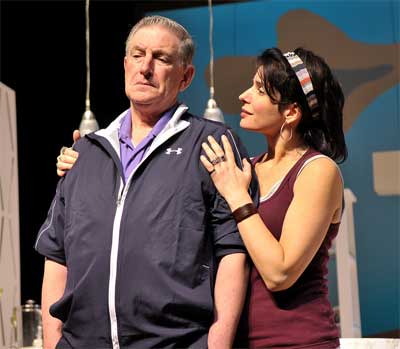
Anne Gottlieb as Brooke
in “Other Desert Cities”
Photo: Craig Bailey/Perspective Photo
Courtesy Speakeasy Stage Company
Much of the play is a long, undramatic preamble to its culmination. It rambles on in a repetitive way, rehashing arguments from Brooke’s side about needing to write and publish the memoir, and from her parents’ side about why she should not publish it.
Much of this interaction seems strange, especially when one considers that Brooke is a writer of some experience. Does it really make sense that she would be so dependent on her parents’ signing off on the idea as she seems to be? That conflict provides the fulcrum for the plot, but it is not that plausible.
Karen MacDonald and Nancy E. Carroll are fine actors, but it is a leap of faith to have cast them as Jews, even assimilated ones. They were both superb as Irish-American types in David Lindsay-Abaire’s wonderful Good People at the Huntington last fall, but, here, it is a more of a stretch for them convey the tonal subtleties of assimilated Jewish-Americans. Since the narrative relies on nuances in the interplay of Jewishness, assimilation and political affiliation, the casting of these roles is of particular significance.
Anne Gottlieb conveys an appropriately fraught Brooke, given the narrative, but there is more adolescent hysteria in this portrayal than might be desirable. A touch more irony and sense of fatalism, in place of impassioned approval-seeking and reaction to its absence, might have played better.
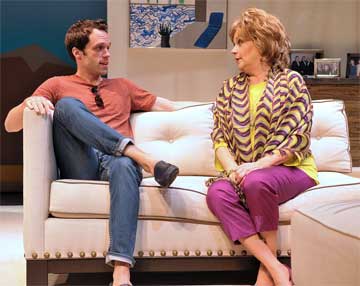
Karen MacDonald as Polly
in “Other Desert Cities”
Photo: Craig Bailey/Perspective Photo
Courtesy Speakeasy Stage Company
The most satisfying speeches, for me, are delivered by Smith (Trip) and Carroll (Silda), in their more peripheral roles. When thrust to declare his position, Smith, as Trip, comes forth acutely. Carroll, as Silda, is also wry, pungent and entertaining when, in private consultation with Brooke, she is able to have her say.
Dialogue for most of this play is written with a kind of carefree quality that does have the echoes of television about it. It is relaxed, rather than dramatically heightened, speech that at intervals turns emotionally overwrought, giving the piece a melodramatic feel.
The rubber meets the road in the ending of this play and it is worth getting there. I was frankly surprised that a play that seemed to be going nowhere, in a not particularly eloquent or convincing fashion for much of its anticipatory two hours, did actually arrive at a destination, and in a compelling way. The narrative choices that bring this about are not entirely plausible, but the dramatic shape of the result is highly effective, yielding a result that lives up to expectations for this well-regarded playwright.
– BADMan
Leave a Reply