• Skip to main content
  • Skip to primary sidebar

Boston Arts Diary

Aesthetic encounters in the Boston area and sometimes beyond

Django Unchained

December 25, 2012 by admin Leave a Comment

Film (2012)

Written and Directed by Quentin Tarantino

Cinematography by Robert Richardson
Film Editing by Fred Raskin

With Jamie Foxx (Django), Christoph Waltz (Dr. King Schultz), Leonardo DiCaprio (Calvin Candie), Kerry Washington (Broomhilda), Samuel L. Jackson (Stephen)
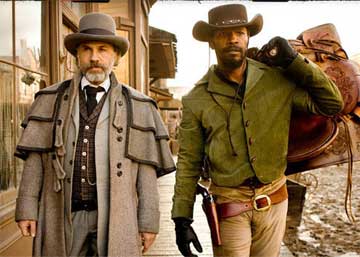
Christoph Waltz as Dr. King Schultz, Jamie Foxx as Django in 'Django Unchained'
Christoph Waltz as Dr. King Schultz
Jamie Foxx as Django
in “Django Unchained”
© 2012 Columbia Pictures
A brutally violent takeoff on a shoot ’em up Western, with the notable and distinctive enhancements of a German bounty hunter and a freed African-American slave.

Dr. King Schultz (Christoph Waltz) is a bounty hunter who enlists the help of a liberated slave, Django (Jamie Foxx), to pursue a particularly big prize. Django is also after a big prize and their pursuits entangle and evolve more than either of them might have predicted.

I was not a big fan of Tarantino’s Pulp Fiction (1994) when it came out. Unlike many, who found it charming and funny despite its over-the-top depiction of violence, I did not. I could not somehow laugh along with it and found the brutalities disconcerting.

Gratuitous violence in works of art cheapens them and is unappealing; but, if violence is used thoughtfully, it can be a compelling vehicle for aesthetic catharsis.
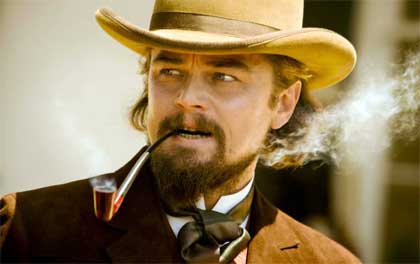
Leonardo DiCaprio as Calvin Candie 'Django Unchained'
Leonardo DiCaprio as Calvin Candie
in “Django Unchained”
© 2012 Columbia Pictures

In recent cinema, the distinctive case I call to mind is Martin Scorsese’s film, Goodfellas (1990), a brutally violent film, but such a good one that the violence, though unsettling, is completely understandable as an aesthetic vehicle.

Here, in Django Unchained, I was struck, during the first two thirds of the film, by how much I liked it. Frankly, I was surprised to find that Tarantino’s offbeat humor, despite the violence, really worked; here it came through loud and clear.

I am inclined to attribute almost the entire reason for the success in conveying Tarantino’s baroque sense of humor to Christoph Waltz’s impeccable performance as Dr. Schultz, the German bounty hunter.

The way his character teeters on the edge of insanity with a wry wildness, while unbelievably exhibiting a severe sense of control and governing intelligence, is distinctive.

While watching Waltz’s performance, I felt like, all of a sudden, I had a sense of what Tarantino has been up to all these years. His narratives work if one can see their brutalities as deeply connected to this explosive relationship between craziness and control.

And to see, in Tarantino’s settings, that this explosive relationship is an effective means for dealing with the world’s insanity gives this aesthetic choice even broader explanatory power.

Though Waltz’s performance here is virtuosic, the other major performances also come through well.

Jamie Foxx is dutifully heroic as Django, the unbound slave. He seethes with awareness as his state changes and he begins to carve out a bit of integrity; as he does so, Foxx gives Django an unbridled grace, as though he begins to dance through his newly found unboundness.

Leonardo DiCaprio is chilling as the villainous plantation owner, Calvin Candie, proprietor of the plantation Candieland. Who knew that sweet, under-appreciated guy from Titanic could be such a cold-blooded beast? He is most vividly and convincingly detestable here in a suavely demonic way.
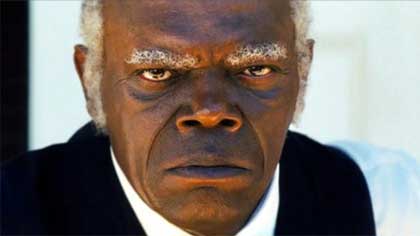
Samuel L. Jackson as Stephen in 'Django Unchained'
Samuel L. Jackson as Stephen
in “Django Unchained”
© 2012 Columbia Pictures

Samuel L. Jackson provides an unblinking and unsettling depiction of a dutiful house slave. It is bizarre to think of his appearance and his role in Pulp Fiction and compare it to this completely different look and disposition. As it did in that earlier film, Jackson’s charisma reverberates.

There are a lot of worthwhile incidental moments throughout.

Jonah Hill has a very funny turn as a Klan leader who holds forth on the liabilities of sheeted-mask wearing during an attempted raid. It is a wryly unrealistic moment, more like a gag from a Woody Allen film, but bizarrely amusing, nonetheless, in its determined satire on a dire practice.

The German theme gets played up in an amusing and unusual way involving a woman slave whose name, derived from the German mythic Brünnhilde, is Broomhilda. That her story in the film fits with the mythical tale of Siegfried, as rendered in Wagner’s Ring of the Nibelungen, is a cute twist.

The last third of the film suffers from a narrative choice that, in the end, weakens its dramatic thrust.

Tarantino had me up to that point and, remarkably, I was getting ready to package it up as one of the great films of the year. It is, for much of it, an extremely good effort, but falls through in those final chapters.

Post-viewing analysis - contains spoilers
This story is surprising compelling up to the point that, at Candieland, the plantation run by Calvin Candie (Leonardo DiCaprio), Schultz buckles to ethical pressure. Until then, the tale seems believable and retains its aesthetic thrust.

When Schultz refuses to shake Candie’s hand and, instead, shoots him in the chest, it seems like Tarantino opts for a narrative direction that does not any longer make sense.

Schultz’s whole modus operandi is resilience and charade. It does not seem in character or believable that he would cave in when the ruse is almost complete.

This provides an all to easy out for Tarantino to make Django the big hero of the gun battle in the end and give a singularly romantic twinge to the finale. But that way of fitting things into a convenient narrative box weakens the whole enterprise.

The only thing that justifies the extreme violence is the compelling sense of irony that Waltz brilliantly conveys through Schultz. When that coherently alienated outlook dissipates in the last third of Tarantino’s script, the aesthetic justification for the brutal bloodbaths is gone.

One might argue that even Schultz buckles under the weight of watching one slave torn apart by dogs and another beaten to death with a hammer. But that argument does not fit the dominant depiction of Schultz as crazy and controlling. This derailing of Schultz’s character feels like a derailing of the whole aesthetic intent, and one walks away wondering why the violent scenes were necessary.

Apparently, Spike Lee strongly objected to Tarantino’s use of the theme of slavery, and these violent depictions, as a cheapening of the theme. With the brutal irony of Waltz’ character intact, one could have made had a stronger case that this was an aesthetically worthwhile, albeit devastatingly brutal, treatment.

Even so, the first two-thirds of the film are compelling and come across well, mostly because of Waltz’s amazing capacity to convey the tone for which Tarantino is clearly striving.

– BADMan

Filed Under: Movies

Reader Interactions

Leave a Reply

Your email address will not be published. Required fields are marked *

Primary Sidebar

Pages

  • Up, and Coming…
    • Boston Area
      • Museums and Galleries
      • Music
      • Theatre
  • Contact Us
  • So Noted…
  • Subscribe to Email Newsletter
  • Supporting Boston Arts Diary
    • Shop at Amazon

Categories

  • Animated
  • Benefits
  • Circus
  • Concerts
  • Costume and Clothing Design
  • Dance
  • Documentaries
  • Festivals
  • Guest Commentary
  • In Memoriam
  • Installations
  • Interviews
  • Lectures and Panel Discussions
  • Movies
  • Museums and Galleries
  • Musicals
  • Operas
  • Operettas
  • Paintings
  • Performance Art
  • Plays
  • Poetry
  • Prints
  • Public Art
  • Puppetry
  • Readings
  • Recordings
  • Reflections
  • Sculpture
  • Storytelling
  • TV
  • Uncategorized
  • Wooden Boats

Archives

Recent Posts

  • When Playwrights Kill
  • Breaking the Code
  • Charlotte’s Web
  • Mistral Goes to Hollywood
  • The Moderate

Twitter

Follow @BostonArtsDiary

Pages

  • Up, and Coming…
    • Boston Area
      • Museums and Galleries
      • Music
      • Theatre
  • Contact Us
  • So Noted…
  • Subscribe to Email Newsletter
  • Supporting Boston Arts Diary
    • Shop at Amazon

Categories

  • Animated
  • Benefits
  • Circus
  • Concerts
  • Costume and Clothing Design
  • Dance
  • Documentaries
  • Festivals
  • Guest Commentary
  • In Memoriam
  • Installations
  • Interviews
  • Lectures and Panel Discussions
  • Movies
  • Museums and Galleries
  • Musicals
  • Operas
  • Operettas
  • Paintings
  • Performance Art
  • Plays
  • Poetry
  • Prints
  • Public Art
  • Puppetry
  • Readings
  • Recordings
  • Reflections
  • Sculpture
  • Storytelling
  • TV
  • Uncategorized
  • Wooden Boats

Archives

Recent Posts

  • When Playwrights Kill
  • Breaking the Code
  • Charlotte’s Web
  • Mistral Goes to Hollywood
  • The Moderate

Twitter

Follow @BostonArtsDiary

Copyright © 2026 · Magazine Pro on Genesis Framework · WordPress · Log in