Film (2012)
Written and directed by Ben Lewin
With John Hawkes (Mark O’Brien), Helen Hunt (Cheryl), William H. Macy (Father Brendan), Moon Bloodgood (Vera), Annika Marks (Amanda), Adam Arkin (Josh), Rhea Perlman (Mikvah Lady)

©2012 Fox-Searchlight Pictures
Mark O’Brien (John Hawkes) is a man in his late thirties almost completely physically incapacitated by polio. He spends much of his day, and night, in an iron lung, but ventures out into the world for several hours at a time. He is a religious Catholic and develops a close friendship with Father Brendan (William H. Macy), a Catholic priest. After a heartbreak with an aide with whom he had fallen in love, he seeks, unexpectedly, to gain some sexual experience with a therapist specially trained to that end. He engages Cheryl (Helen Hunt) in that capacity and so begins a series of encounters – the eponymous sessions – during which Mark gradually learns how to have a sexual encounter.

©2012 Fox-Searchlight Pictures
Mark’s progress in sex therapy forms the core of this tale, but it is really the evolution of the more subtle and penetrating aspects of the relationship with Cheryl that shape the drama.
Though he is seriously impaired and highly vulnerable, it is evident from the outset that Mark is hilarious and charming. The various people with whom he has contact – most of them his health aides – are immediately drawn to him, and the momentum of the story comes from the unexpected effects of that charm.
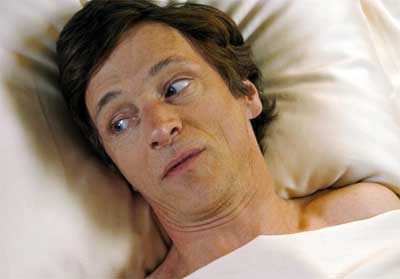
©2012 Fox-Searchlight Pictures
The writing, especially for Mark, is wonderfully witty. And John Hawkes, with a beautiful combination of softness and blunt irony, contributes a vivid sense of this character’s sensitive and wry personality.
Helen Hunt, as Cheryl, the businesslike therapist, is exceedingly good at navigating he role between professionalism and susceptibility. Though physically exposed repeatedly, she cautiously reveals her self, only doing so hesitantly and demurely. Hunt’s deft physical grace and adeptly meted emotionality combine to provide a performance which is truly a revelation about revelation. She literally and figuratively pulls it all off while conveying a self-reliant nobility.
Though its narrative is about the sexual education of a disabled man, the film’s more subtly captivating quality derives from the penetrating way in which it conveys how, for anyone, fulfilling sexuality unfolds within the more subtle textures of relationship.
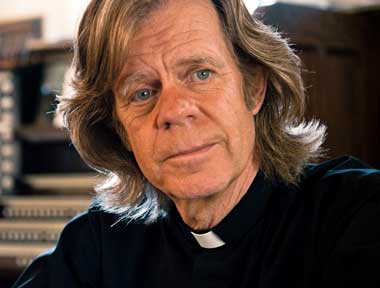
©2012 Fox-Searchlight Pictures
William H. Macy (Father Brendan), bedecked in flowing locks, is Mark’s priest, and wonderfully funny. The most hilarious line in the film comes from him. When Mark asks Father Brendan about seeking a sex therapist, the priest looks at Mark, pauses, and asks: You mean fornication? Mark nods affirmatively, and the priest then looks up at a statue of Mary, pauses in a moment of reflection, then turns to Mark and definitively responds: Go for it! Macy has just the right combination of embarrassed constraint and internal rambunctiousness to pull off this kind of line perfectly.
This long-haired, beer-drinking, down to earth priest is an endearingly complex character in the mold of Karl Malden’s Father Barry from Elia Kazan’s classic 1954 film On The Waterfront, reassuringly human and vulnerable in an age in which accounts about certain clerics whose authoritarianism has shrouded morally contemptible actions have come to light.

©2012 Fox-Searchlight Pictures
Moon Bloodgood plays Mark’s somewhat restrained but utterly engaging aide, Vera. She has a serious gaze that draws us in, and, at the same time, a subtle sensuality that comforts us once we get there.
Adam Arkin, a fine actor, has a small role here as Cheryl’s husband, Josh, and Rhea Perlman has a cameo as a mikvah (Jewish ritual bath) attendant. It is nice to see them here, however underused.
Much of the writing is very good, in particular Mark’s role, which is endearing and funny. But some of the writing does not hit home quite as well. There is a general tendency towards sentimentality which often gets offset by the wryness of Mark’s humor, but sometimes not sufficiently so.
The interaction between Cheryl and her husband, Josh, seems to swing from a too sweetly idealized acceptance of her unusual profession to a too conflicted inflammation when it takes an emotional turn, without enough explanatory texture between.
Both Mark and Cheryl are Bostonians who have moved to Berkeley, California. Hunt’s character, unfortunately, has an intermittently annoying variant of a Boston working-class accent which screams I am not from Boston but I am trying really hard to sound as though I am.
By this point, filmmakers should realize that it is better to soft-pedal the stereotypical Boston accent and give an inviting hint to it, rather than blare it out loud and and invite laughter, especially from those who know better.
– BADMan
Leave a Reply