Film (2012)
Written and directed by Leos Carax
Kendall Square Cinema
Cambridge, MA
Cinematography: Caroline Champetier, Film Editing: Nelly Quettier, Set Design: Florian Sanson, Music: Neil Hannon, Sound: Erwan Kerzanet
With Denis Lavant (M. Oscar / Le banquier / La mendiante / L’OS de Motion-Capture / M. Merde / Le père / L’accordéoniste / Le tueur / Le tué / Le mourant / L’homme au foyer), Edith Scob (Céline), Eva Mendes (Kay M), Kylie Minogue (Eva Grace), Elise Lhomeau (Léa), Jeanne Disson (Angèle), Michel Piccoli (L’homme à la tache de vin), Leos Carax (Le dormeur / Voix Limousine), Nastya Golubeva Carax (La petite fille), Reda Oumouzoune (L’acrobate Mo-Cap), Zlata (La cyber-femme), Geoffrey Carey (Le photographe / Voix Limousine), Annabelle Dexter-Jones (L’assistante photographe)
A man who we only know as Mr. Oscar (Denis Lavant) leaves a nice, modernist home in the suburbs and gets in a car driven by his perhaps omniscient chauffeuse, Céline (Edith Scob), seeming to head towards Paris. Soon afterwards, he begins a series of adventures for which he transforms himself remarkably through costume and makeup and engages in dauntingingly cathartic acts.
This vivid and offbeat film has virtually no single narrative to it, but manages, over the course of a couple of hours of appalling and unsettling events, to deliver an effect, and indirectly some kind of message about the human condition, the nature of persona, and the transiency of life.
The protagonist is a makeup specialist and each of the multiple adventures he undertakes involves a dramatic change of garb. At the outset, he goes from looking like a sleek middle-aged business professional to looking like an old, very hunched-over, woman.
Revealing scenes (complete with the protagonist’s erect penis), replete with snakes and many other discomfiting additions, and any number of extreme shots of people that would make Diane Arbus proud, abound.
For Paris lovers, there is a visit to the grand Père Lachaise cemetery, down and through the famous sewers, and to the roof garden of the well-known department store, La Samaritaine, where one looks out from behind its large lettered sign.
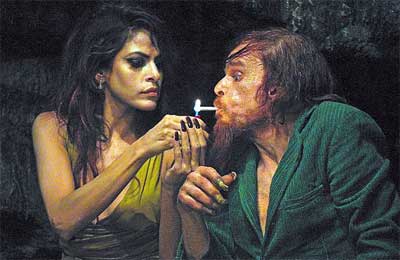
(in one of his many incarnations)
Photo: Pierre Grise Productions
Denis Lavant, in the title role, is pretty amazing, conveying quite believably the whole range of roles he undertakes.
Quite a few international stars abound here, including the magnetic Eva Mendes, who does a turn as Beauty to Mr. Oscar’s Beast.
Despite its harsh, contemporary visual tone, the sound track not infrequently calls to mind that great sentimental piece of modern French opera-cinema, The Umbrellas of Cherbourg (1964), adding one more oddly jarring piece to this great melange of philosophy, theatricality and irony.
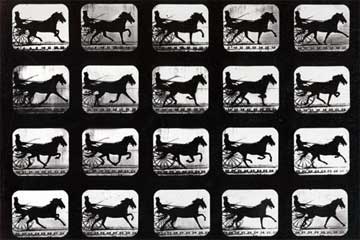
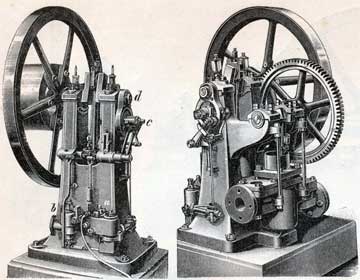
Early serial photo images from Eadweard Muybridge (1830-1904) are quoted at various intervals in the film presumably to call to mind the association of cinema, image, disguise, the simulation of life, and anything else metaphysically interesting. Presumably, the title of the film, in addition to pointing to the metaphorical significance of cars in the film, suggests the motors that drive cameras and projectors. The film obviously gives one lots of room for interpretation here.
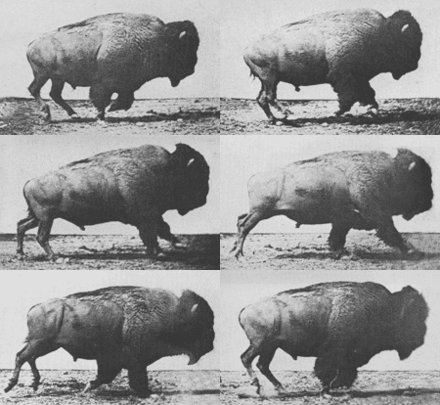
constructed from an
Eadweard Muybridge study
from the late 19th century
There is the poetic implication that somehow the car in which Mr. Oscar has traveled – and in which each of us travels – is a metaphysical vehicle of some kind. And, in the end of the film, to reinforce that notion in a comedic vein, we witness an entire garage of them breaking into wild, animated conversation.
Do not go to this film looking for a conventional story of any kind. But, if you have a taste for the bizarre and cathartic, you may enjoy its wild cascade of vivid images, and hazily conceived, but nonetheless amusing and suggestive, ideas.
– BADMan
Leave a Reply