Film (2010)
Directed by Banksy
With Banksy, Shepard Fairey, Thierry Guetta
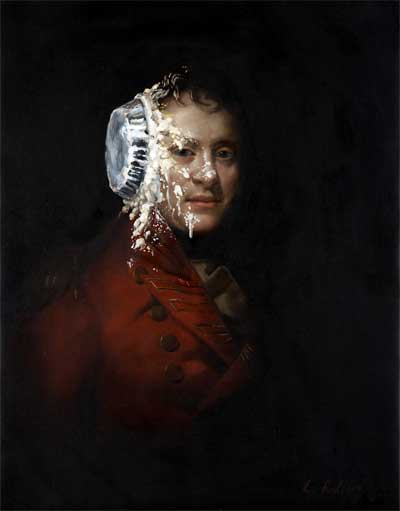
Image by Banksy, courtesy of Banksy – Inside Outside Shop
I had read that this was a film about the graffiti artist, Banksy, but it is only partially so. It is really about the character who enters episodically at the beginning of the film, Thierry Guetta, a former clothing store owner (he elaborates on his ability to sell fringe-wear as couture), who starts out as a hobbyist documentarian of graffiti artists and finally turns into – or wills himself to turn into – a graffiti artist himself, aka Mr. Brainwash. This film is very funny, largely because Guetta is such a ready buffoon and because the brief and to the point comments by the mysterious Banksy about Guetta are so withering and true.
When, in the flow of events, Banksy is asked to give a publicity quote for Mr. Brainwash’s first art opening, it turns out to be: Mr. Brainwash is a force of nature, a phenomenon, and I don’t mean that in a good way. It’s funny, striking, and true to the point.
Guetta only has turned into an artist because Banksy, having seen his first attempt at producing a film, is so appalled that he suggests anything to get Guetta away from filmmaking. So he suggests that Guetta work on further developing his street art, which, up to this point, has involved pasting his own image in various sizes on walls around Los Angeles.
But Guetta (as Mr. Brainwash) takes this suggestion by Banksy as a spirited encouragement to join the ranks of the enlightened – as a blessing to become one of Banksy’s own – and he goes at it full tilt. Somehow, by the full force of his will and personality, he manages to mount a huge exhibition of works – to say they were derivative would be a true diminution of the term – and thousands of people come. It is an amazing commercial success – Guetta sells over a million dollars of works at the show, which continues on for months after its intended run.
Only now does the title of the film become clear: that this buffoon, barely trained, educated or seasoned in any branch of the art world, enters it like a major player and gains notoriety and wealth by turning himself into a vehicle for publicity, and whatever he produces into a commodity.
The wonderful thing about the withering condemnation of Guetta by Banksy, and others, is that they are all alternative artists. They are not straight-laced members of the gallery set, but rogues who are practiced in putting their works in odd public places and skating on the thin edge of the law to do so. They are not academic artists by any stretch of the imagination, but they regard Guetta as a phony, a Johnny Come Lately, who thinks that he can scramble around, put all sorts of weird stuff together, and all of a sudden become an artist.
Having just been to lots of galleries and museums in the past week, I can sympathize with their species of criticism, but I’d extend it further. I won’t say exactly which contemporary artists of considerable renown I’d think might have offered more appropriate gifts to culture as shoe salespeople, but the thought certainly crossed my mind as I wandered down the hallways of noted galleries and viewed what I was told were highly valued aesthetic artifacts.
Truly a lot of the art world is about the commoditization of art and it is only the strangeness of that judgment within the realm of graffiti and outsider artists about one of their own that makes this particular film offbeat. But, transpose it to the world of contemporary art taken somewhat more seriously in galleries and you have a commentary which is not so offbeat but equally true.
How do we distinguish what is worthy of aesthetic acclaim from what is simply valued with a price tag or an honored position in a gallery? That is a question for all of us to continue to take seriously and to try to make a practice of answering honestly. And we should raise this question within whatever sector of the art world we find ourselves traveling.
This is a funny and rough film set in the world of graffiti and fringe artists, but it is very much to the point about the distinction between the urge to make good art and the urge to make a splash, to make a name and to make a fortune.
Some have speculated that the film is a put-on by Banksy. Maybe it is – but it is funny as hell anyway, and the prodding it gives us – farce or not – to think about the commercialization of art is entirely worth it.
By the way – the studio logo screen at the opening of the film has the look of a Paramount logo, until one reads it carefully and sees that it says Paranoid Films and is highlighted by a sequence of bullet holes that appear in a sequence of shots around it. It’s a great setup for what is to follow.
– BADMan
Leave a Reply