Play by William Shakespeare
Actors’ Shakespeare Project
The Modern Theatre at Suffolk University
Boston, MA
Directed by Adrianne Krstansky
With James Andreassi (Antony), Siobhan Juanita Brown (Mardian), Jesse Hinson (Demetirus), Doug Lockwood (Octavius), Johnnie McQuarley (Philo), Paula Plum (Cleopatra), Mara Sidmore (Charmian), Richard Snee (Enobarbus), Giselle Ty (Iras, Octavia)
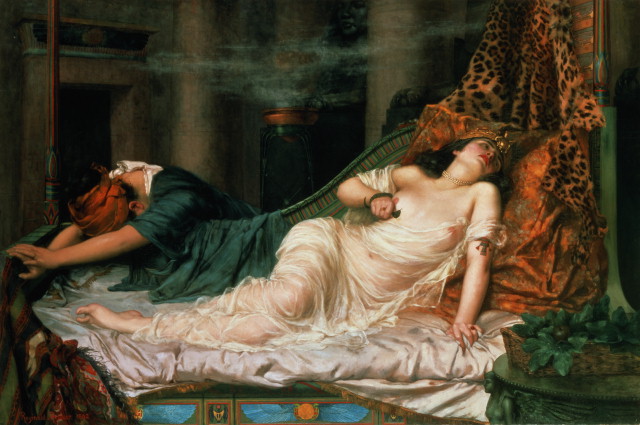
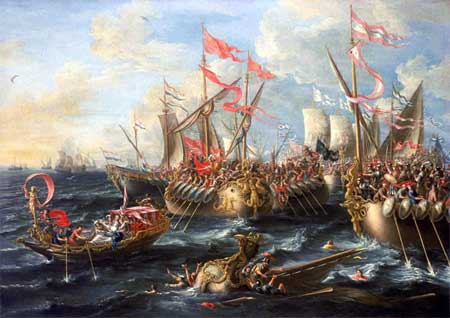
A typically challenging plot from The Bard: After Julius Caesar’s assassination, Mark Antony, a great Roman general, is in a triumvirate rulership with Octavius Caesar and Lepidus. The arrangement is not brilliant. Octavius is upset that Mark Antony is off in Alexandria (Egypt) having a romance with Cleopatra and not attending to matters at home. Principal among these matters is the issue of dealing with the military onslaught of Sextus Pompey, who is challenging the triumvirate’s authority.
Least among the problems is that Mark Antony is married to a Roman named Fulvia while he’s dallying with Cleopatra. But Fulvia dies, Mark Antony goes home to pay his respects – such as they are – and winds up marrying Octavius’ sister Octavia.

Even though this is a marriage of convenience, more to allay Octavius’ anger about Mark Antony’s lack of corporate performance, it does not sit too well with Cleopatra. But Mark Antony goes back to her, they argue, and, still lovers, go back to their torrid romancing. Meanwhile, military matters get extremely confusing, and the triumvirate pulls apart. In the end, it is not clear who is on whose side, and whether, when Cleopatra’s ships move forward and back whether they are meant to help Mark Antony or not. The end is tragic, much akin to what happens in Romeo and Juliet. The impassioned speeches by Mark Antony and Cleopatra as they culminate their tragic conclusion are the most intense and satisfying parts of the play.

The first Actors’ Shakespeare Project play I saw was Julius Caesar seven or so years ago. It was produced at the YMCA in Central Square in Cambridge. Done with homemade sound effects, simple staging, but top notch acting and direction. I was so taken with the quality of that production that I became a great fan of the group and have attended almost all of their productions since. On balance, the quality has been extremely high.
ASP has performed all over town. I have seen them at the basement of The Garage in Harvard Square, on the stage of the Strand Theatre in Dorchester, in Hibernian Hall in Roxbury, in hallways in Boston University, at the Cambridge Multicultural Arts Center, Fort Point Channel, the Somerville Armory, and at a storefront in Davis Square, Somerville, and there are probably a few more locations I’ve failed to mention.

One of the great accomplishments of the ASP (and I should note the particular relevance of the theatre’s acronym to the current production) is its capacity to achieve a great sense of intimacy with its audiences. Some of this is due to the quality of the unorthodox theatrical spaces it has inhabited. And some of it has to do with the fervor with which the theatre has preserved a sense of technical simplicity in its productions. That simplicity has enabled the words and the drama of Shakespeare’s plays to rise up off the stage unencumbered.
The current production is the first one that I have seen produced in a theatre, on a stage, while sitting in the audience. (For its production of Hamlet, some years ago, done at the Strand Theatre in Dorchester, the audience sat on the stage, while the action took place on the remainder of the stage and in the rest of the theatre.) But there is something about this current production – with its access to full theatrical facilities – that compromises, rather than serves, the drama in the way that ASP traditionally has done.
Most obviously, the sound system is overused and over-amplified, with metallic rock music blared at intervals. Though the intention of this is to call to mind the theme of war so central to the plot, the result dampens the drama and reduces the theatrical intimacy which ASP has otherwise so adeptly cultivated. Oddly, and despite the aural over-amplification, the production seems muffled.
James Andreassi, as Mark Antony, seems continually boisterous until he begins to die, at which point he settles down. (It made me wish his end had come sooner and been slower.) Though Paula Plum’s Cleopatra is not as boisterous, she too does not seem to settle into the meat of her role until the final scenes.
To some extent, this is the fault of the play, which, for its first two-thirds, has such an abundance of goings on between Rome and Alexandria that it is hard to get much of a sense of anyone’s place. But, in the end, the tragedy makes things slow down and the brilliance of Shakespeare’s capacity to articulate feeling shines through. But, this production could have helped the play along much more effectively.
I saw Antony and Cleopatra at Shakespeare and Company in Lenox, MA, a few years ago with its artistic director, Tina Packer, in the role of Cleopatra. Somehow, in that performance, Packer conveyed a sense of guts and tautened passion that was not present in this production.
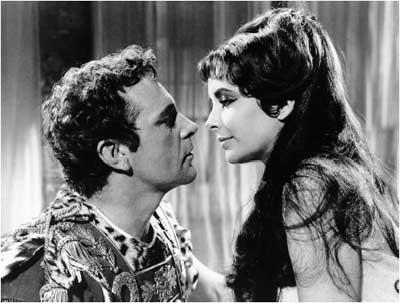
I did see the current production very early in its run, and it may indeed mature. And, indeed, the final scenes are done in a penetrating and evocative way.
For years, the ASP relied on its in-house troupe of actors for many of the performances, but this year many of the roles have been filled by newcomers. There is a quality that emerges when an established company works together in production after production, and, that, too, may contribute to some of the apparent lack of settledness in this case.



– BADMan
Leave a Reply