Film (2026)
based on Jane Austen’s novel Sense and Sensibility (1811)
Screenplay by Diana Reid
Directed by Georgia Oakley
Production Company: Working Title Films
Distributor: Focus Features
Cinematography: Arnaud Potier; Film Editing: Izabella Curry; Music: Roger Goula
With Daisy Edgar-Jones (Elinor Dashwood); Esmé Creed-Miles (Marianne Dashwood); Caitríona Balfe (Mrs. Dashwood); Bodhi Rae Breathnach (Margaret Dashwood); Frank Dillane (John Willoughby); Herbert Nordrum (Colonel Brandon); George MacKay (Edward Ferrars); Fiona Shaw (Mrs. Jennings); Stacy Martin (Fanny Dashwood); Tom Brooke (John Dashwood); Turlough Convery (Sir John Middleton); Chloe Pirrie (Lady Middleton); Eliot Sumner (Mr. Palmer); Bethany Slater (Mrs. Palmer); Ceara Coveney (Lucy Steele)
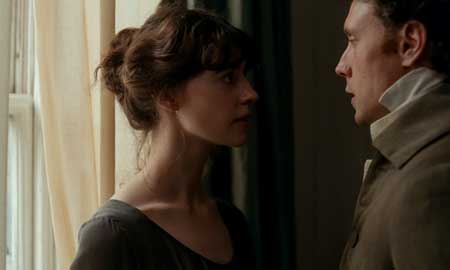
George MacKay as Edward
in “Sense and Sensibility”
Photo: Amy Rivera
Courtesy of Focus Features and Working Title Films
Henry, the father of the three Dashwood girls, Elinor (Daisy Edgar-Jones), Marianne (Esmé Creed-Miles) and Margaret (Bodhi Rae Breathnach), has died, and upon leaving Barton Park, his estate, to his son John (Frank Dillane) as per the traditions of the day, had sought to gain John’s confirmation that he would responsibly see after his widow, Mrs. Dashwood (Caitríona Balfe) – John’s stepmother – and her (and Henry’s) three daughters. Weak, and influenced by his unkind and insensitive wife, Fanny (Stacy Martin), John renounces responsibility for his stepmother and half-sisters, forcing them to move to a very modest country house in Devonshire.
Before leaving Barton Park for their more modest dwelling, the mother and three daughters get to meet Edward Ferrars (George MacKay), Fanny’s kind and sensitive brother, who comes for a visit. Intelligent and sensitive Elinor, the oldest of three Dashwood sisters, finds herself drawn to Edward, though this attachment is not regarded with approval by Fanny, who deems that her brother seek a more socially elevated match. But Edward is taken with Elinor. The mother and girls move to the new country dwelling and, by and by, meet up with Colonel Brandon (Herbert Nordrum), a serious and somewhat uncommunicative sort who seems quietly drawn to the animated, lively and spirited Marianne. At some point, Marianne is out walking, falls and sprains her ankle, and is rescued by the dashing John Willoughby (Frank Dillane) to whom Marianne takes an immediate fancy.
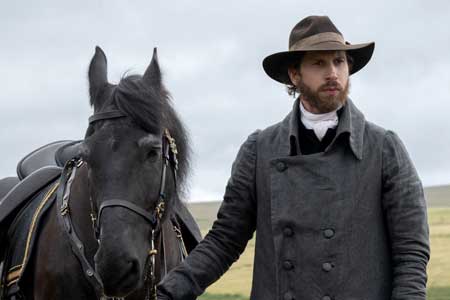
in “Sense and Sensibility”
Photo: Amy Rivera
Courtesy of Focus Features and Working Title Films
Suffice it to say that things get complicated. Elinor, who is smitten with Edward, does not really hear much from him when she moves away, which distresses her immensely. Marianne and Willoughby see a great deal of one another in Devonshire, leading to a presumption on Marianne’s part, and on the part of the family, that they are as good as engaged. Willoughby goes off to London for a stretch to take care of family business and Marianne also does not hear too much from him. On a visit to Barton Park, Elinor meets the seemingly frivolous Lucy Steele (Ceara Coveney), who indicates that her own relationship to Edward is a bit more than Elinor had hoped. An invitation to visit London from a vague relative, Mrs. Jennings (Fiona Shaw), offers Elinor and Marianne the opportunity to encounter Edward and Willoughby at a large society ball, and the results are more complicated than hopeful. (See spoilers section below for the follow-up and denouement.)
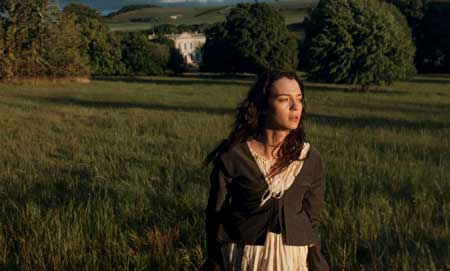
in “Sense and Sensibility”
Photo: Amy Rivera
Courtesy of Focus Features and Working Title Films
This is a truly terrific production, with first-class acting and direction. The nuance of gesture and expression by Daisy Edgar-Jones as Elinor is extremely persuasive, an offering of dramatic range that compels with its subtlety and grace – it is almost intoxicating to watch the nuance of changes in Edgar-Jones’ face. Following closely are the performances by George MacKay as Edward, whose quiet nobility radiates beautifully, and by Herbert Nordrum as Col. Brandon who offers a stern but sympathetic portrayal that is seductive in its silent magnetic pull. The performance by Esmé Creed-Mile as Marianne is energetic and appealing, with a wonderful turn towards the subtly reflective at the end. As Mrs. Dashwood, Caitríona Balfe is appealingly maternal, Fiona Shaw as Mrs. Jennings is charmingly animated and funny, and as Margaret, Bodhi Rae Breathnach is pixie-ishly supportive. All in all, the range of performances is so good that one credits not only the very good actors, but the fine direction by Georgia Oakley.
The production values of the film are also exquisite. The cinematography is beautifully done, the music and sound track by Roger Goula is interesting but more or less appropriate for the era, and supportive of the drama but not intrusive. Costumes, sets and production are nicely designed, and, distinctively, choreography of the balls is uniquely satisfying and dynamic. Cinematography by Arnaud Potier and film editing by Izabella Curry are excellent. All around, production values are very high.
Indeed, this is a creditable rendition of the novel. The 1995 film by Ang Lee, with Emma Thompson, Kate Winslet, Hugh Grant and Alan Rickman is by now a classic and wonderful in its own right. The current film is certainly an equal to that one and, in some ways, embellishes and extends the nuances of portrayals in a deeply satisfying way.
– BADMan (aka Charles Munitz)
Leave a Reply